


Search intent drift is what happens when the searches triggering your Google Ads slowly move away from the buyer you meant to reach, while your keyword list, ad copy and reports still make everything look relevant. The queries sound right. The clicks arrive. The budget disappears. The enquiries, bookings and sales never show up.
If you run Google Ads for a business in Sydney, Melbourne, Brisbane, Perth, Adelaide or Canberra, you have probably seen it in your Search Terms Report: a long list of phrases containing your service words, yet hardly any that belong to someone ready to hire you. This guide explains why search intent drift happens, how to find it inside your account, and how to fix it without strangling your campaigns.
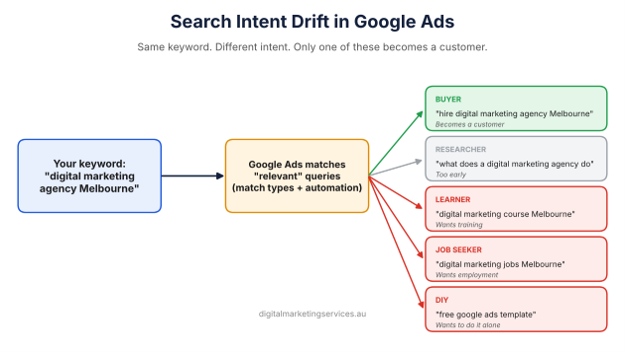
What Is Search Intent Drift in Google Ads?
Search intent is what a person actually wants when they type a query into Google Search. It usually falls into four groups: informational (learning something), navigational (finding a specific website), commercial investigation (comparing options) and transactional (ready to act). Search intent drift is the gradual slide of your paid traffic away from transactional, high-intent searches and into informational, job-seeking, learner or plainly irrelevant ones.
The word “drift” matters. Nobody builds a campaign to attract people hunting for free templates or training courses. It happens slowly, through match type expansion, automated bidding, seasonal behaviour and a Search Terms Report that nobody has time to read every week. Because the queries still share words with your keywords, they survive a quick glance. Google Ads calls them relevant. Your bank balance disagrees.
Why Search Intent Drift Happens
Search intent drift is rarely one mistake. It is usually several small settings working together. These are the most common causes we see when auditing Australian accounts:
- Broad match and close variants. Broad match lets Google show your ad on searches it considers related to your keyword, which can stretch well beyond what you intended. “Digital marketing agency” can quietly become “digital marketing diploma”.
- Smart Bidding learning from weak signals. If your main conversion is a page view, a phone number click or a newsletter signup, strategies like Target CPA or Maximise Conversions will find more of those actions, not more paying customers.
- Performance Max and automated expansion. Performance Max can serve across Search, YouTube, Display, Discover, Gmail and Maps. Limited query visibility makes drift harder to see and slower to correct.
- Ambiguous keywords. Words like “marketing”, “plumber” or “accountant” are shared by buyers, students, job seekers and competitors.
- Ads that do not filter. If your ad copy and landing page never mention who the service is for, where it operates or roughly what it costs, everybody clicks.
- No review rhythm. The Search Terms Report is where drift is visible, but only if someone reads it on a schedule.
Queries That Sound Relevant but Never Become Customers
Search intent drift tends to follow patterns. Once you recognise them, your Search Terms Report starts to read very differently. Here are the six patterns that waste the most budget:
| Query type | Example search | Why it never converts | Fix |
| Learner | “digital marketing course Melbourne” | Wants training, not an agency. | Negatives: course, training, diploma, certificate. |
| Job seeker | “google ads jobs Sydney” | Wants employment, not a service. | Negatives: jobs, careers, salary, internship. |
| DIY researcher | “how to set up google ads” | Wants a tutorial, not to pay for management. | Phrase negatives plus an informational content page. |
| Freebie hunter | “free seo audit tool” | Wants software or zero cost. | Negatives: free, tool, software, template. |
| Out-of-area | “seo agency Brisbane” from a Perth searcher | Cannot use your service. | Use presence-based location targeting. |
| Navigational | “competitor name login” | Looking for another brand. | Add competitor brand names as negatives. |
How to Spot Search Intent Drift in Your Search Terms Report
You do not need special software to find search intent drift. You need 30 focused minutes and a willingness to look at the ugly queries. Follow this process:
- Open the Search Terms Report in Google Ads and set the date range to the last 90 days, or longer if your volume is low.
- Sort by cost, not clicks. Your top 50 spending queries tell you where the money really went.
- Label each query by intent: buyer, researcher, learner, job seeker, DIY, competitor or irrelevant.
- Compare each label against qualified leads from your CRM, not only the conversions Google Ads records. This step exposes the gap between “conversions” and customers.
- Flag any intent group that consumes meaningful budget but produces no qualified leads. Set your own threshold, for example 10 per cent of spend.
- Check the search term insights and category views where available to spot themes you would miss reading line by line.
Pair this with the Google Ads Help Centre documentation on search terms and match types so your team uses the same definitions. If your conversion data looks suspicious, our article on tracking problems in the digitalmarketingservices.au blog explains how reporting drifts after website changes.
How to Fix Search Intent Drift Without Killing Your Campaigns
1. Build a layered negative keyword strategy
Negative keywords are your first line of defence against search intent drift. Create shared negative lists for learners (course, training, certificate, diploma), job seekers (jobs, careers, salary, internship) and DIY searchers (template, free, tutorial), then apply them at account or campaign level. Review them quarterly, because every business has exceptions. If you sell training, “course” is a keyword, not a negative.
2. Tighten match types around your money terms
Use exact and phrase match for core commercial keywords. Keep broad match only where your conversion tracking is clean and your audience signals are strong, and watch it closely. Accuracy first, scale second.
3. Split campaigns by intent tier
Separate high-intent terms (hire, quote, near me, emergency, book) from mid-intent comparison terms (best, reviews, pricing) and low-intent research terms. Give each tier its own budget, bidding target and landing page. Search intent drift cannot hide when every tier has a clear job and its own report line.
4. Write ads that filter the wrong clicks
A good ad repels as well as attracts. Mention your service area, your customer type and a price signal where you can. “Digital marketing for Melbourne businesses. Request a quote” loses the job seeker before they cost you a click. Back it up with sitelinks, callouts and location assets that reinforce who you serve.
5. Feed Smart Bidding better conversion data
Set up conversion tracking with Google Tag Manager and Google Analytics 4, turn on enhanced conversions, and import offline conversions from your CRM so Google learns which clicks became customers. Our PPC and Google Ads management service builds this measurement layer before touching bids, because automation is only as smart as the signals it receives.
6. Match the landing page to the intent
A visitor searching “google ads agency Perth” should land on a page about Google Ads management in Perth, not a generic homepage. Intent-matched pages lift conversion rates and give Google clearer relevance signals. Our SEO services team often builds these pages so paid and organic traffic support each other.
7. Tighten location settings
In campaign settings, choose the option that targets people in or regularly in your locations, rather than people who merely show interest in them. This single change removes many out-of-area clicks from searchers who never intended to buy from you.
Search Intent Drift Across Australian Cities
Search intent drift looks different depending on where you advertise. The patterns below are tendencies, not rules, so test them against your own data:
- Sydney and Melbourne: large agency and education markets tend to attract more learner and job-seeker queries on generic service terms.
- Brisbane and Perth: suburb-level and “near me” searches are common, so location settings and local landing pages matter most.
- Adelaide and Canberra: smaller search volumes mean a handful of wasted clicks can distort an entire month of results. Canberra also sees public-sector and government-related searches that may not suit private-sector offers.
If you want a city-specific review, see our Locations page or contact the team directly. We work with businesses in Melbourne, Sydney, Brisbane and beyond, and can also support Adelaide, Canberra, Hobart and Perth clients online.
How to Measure Whether Search Intent Drift Is Fixed
Fixing search intent drift is not about getting fewer clicks. It is about getting better clicks. Track these metrics together:
- Cost per qualified lead, not just cost per conversion.
- Lead-to-sale rate by campaign and by intent tier.
- Share of spend on non-buyer queries, measured monthly from the Search Terms Report.
- Return on ad spend (ROAS) calculated from CRM revenue where possible.
- Impression share on high-intent exact terms, so you are not losing buyers while trimming waste.
For wider guidance on creating helpful, intent-matched pages, Google’s own helpful content guidance is worth a read, and Think with Google publishes consumer behaviour research that helps explain why intent shifts. Industry publication Search Engine Land tracks Google Ads changes that can affect match behaviour.
Search Intent Drift Checklist
- Review the Search Terms Report weekly for new campaigns and at least monthly for stable ones.
- Maintain shared negative keyword lists for learners, job seekers and DIY searches.
- Use exact and phrase match for core commercial terms.
- Separate campaigns by high, mid and low intent.
- Import CRM outcomes so bidding learns from real customers.
- Use presence-based location targeting.
- Give every service and city its own matching landing page.
- Report on cost per qualified lead, not just clicks and conversions.
Search Intent Drift FAQs
What is search intent drift in Google Ads?
Search intent drift is the gradual shift of the searches that trigger your ads from buyer-ready queries to research, learner, job-seeker or irrelevant ones, often caused by broad match, automation and weak conversion signals.
How often should I review my Search Terms Report?
Weekly for new or high-spend campaigns, and at least monthly for mature ones. Search intent drift builds quietly, so a regular rhythm beats an occasional deep clean.
Do negative keywords completely fix search intent drift?
No. Negative keywords remove known waste, but intent-tiered campaigns, better ad copy and cleaner conversion data are what stop new waste from appearing.
Can Performance Max cause search intent drift?
It can, particularly when conversion goals are loose or when there is little visibility into search queries. Strong audience signals, good conversion data and regular reviews reduce the risk.
Stop Paying for Searches That Never Become Customers
Search intent drift is not a sign that Google Ads does not work. It is a sign that your account needs closer supervision than the default settings provide. When your keywords, ads, landing pages and conversion data all point at the same buyer, the budget follows.
If you suspect your account is leaking spend, request a free marketing review and our team will examine your search terms, match types and tracking. You can also learn more about our digital marketing services, read our FAQs, meet the team, or call 1300 649 299.