


Branded search credit is the quiet reason a Google Ads report can look brilliant while your real sales barely move. A person hears about your business from a friend, a review, a podcast or a truck driving past, types your name into Google, clicks the ad at the top and buys. Google Ads records a conversion and takes the bow. Your marketing meeting then celebrates a campaign that did not actually create that customer.
If you run paid search in Australia, this matters more than almost any other reporting issue. Brand terms are cheap, they convert at a very high rate, and they sit right at the end of the buying journey. Together, those three facts make branded search credit one of the easiest ways to overstate return on ad spend. This guide explains how the problem works, how to spot it in your own account, and how to fix it without wrecking the demand you genuinely need to protect.
What Is the Branded Search Credit Problem?
The branded search credit problem is the gap between the conversions Google Ads reports on searches that include your business name and the conversions those ads truly caused. A branded search is any query containing your company name, product name, domain or a close misspelling. The person typing it already knows you exist. They are not discovering you, they are looking for you.
Google Ads is not lying when it claims those conversions. The platform is simply reporting what happened inside its own walls: a click on an ad, followed by an action on your site. What it cannot tell you is whether that customer would have arrived anyway through your organic listing, a direct visit or a saved bookmark. That missing counterfactual is where branded search credit quietly piles up.
Think of it like a shop that hires a greeter to stand at the front door. Every customer who walks in gets welcomed, and the greeter’s tally looks fantastic. But most of those people were already walking through the door. Counting every one of them as a sale the greeter generated tells you very little about whether the greeter is worth the wage.
Why Google Ads Claims Customers Who Already Know Your Business
Several things work together to hand paid brand ads so much credit. None of them are bugs, which is exactly why they go unnoticed.
Brand searches sit at the bottom of the funnel
Someone typing your business name is usually ready to act. They want your phone number, your pricing page, your booking form or your checkout. Because intent is so high, brand campaigns tend to show a very strong conversion rate and a very low cost per acquisition. On a spreadsheet, they look like your best campaign. In reality, they are harvesting demand that other channels, and often plain reputation, planted long before.
Attribution models reward the last touch
Google Ads currently uses data-driven attribution as the default for most conversion actions, and it can still give weight to the final ad click on a branded query. You can read how it assigns credit in Google’s own explanation of data-driven attribution and its overview of attribution models. Even a smarter model is still a model, and it only sees paths that include an ad interaction. Customers who found you through a podcast, a referral or a Facebook post and then clicked a brand ad get recorded as a paid search win.
Automation loves cheap, easy conversions
Smart Bidding and Performance Max are built to find conversions at the lowest possible cost. Branded queries are the cheapest conversions in your account, so automated campaigns drift toward them. Left unchecked, a campaign that was meant to win new customers can end up spending a large share of its budget on people who typed your name into the search bar.
This is why a branded search credit review should sit near the top of every paid search audit. If you also struggle to reconcile platform numbers with your CRM, our article on lead attribution and why Google, Meta and your CRM disagree covers the wider picture.
A Simple Example of Branded Search Credit in Action
Imagine a Melbourne plumbing company spending a few thousand dollars a month on Google Ads. The dashboard shows 60 conversions at an attractive cost per lead. Everyone is happy. Then someone splits the report by search term.
Forty of those conversions came from searches containing the company name. When the owner pauses the brand campaign for two weeks as a test, enquiries from the website dip only slightly, because most of those people simply click the organic result instead. The truly incremental conversions turn out to be closer to 14, and the rest were branded search credit that Google Ads had claimed for itself.
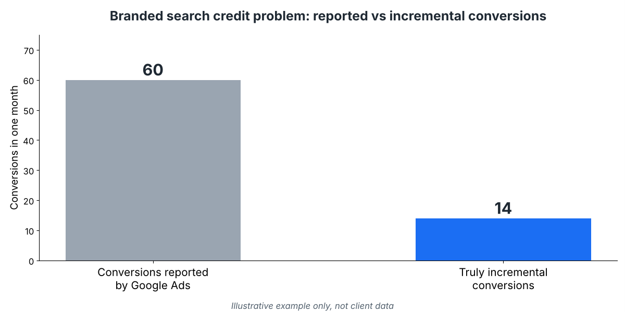
The numbers above are an illustration, not a benchmark. Your own split will depend on your brand strength and organic rankings.
How Branded Search Credit Distorts Your Marketing Decisions
Inflated brand numbers are not just a reporting nuisance. They change what you do with real money.
- You overspend on bottom-funnel ads. When brand campaigns look like heroes, budgets flow toward them and away from the awareness work that creates new demand.
- You undervalue SEO and content. If paid brand clicks steal credit from organic visitors, your SEO services can look weaker than they really are.
- You misjudge new-customer cost. Blending brand and non-brand results hides how expensive it truly is to win someone who has never heard of you.
- You trust automated bidding too much. Smart Bidding optimises toward the easiest conversions, which are often branded ones.
Signs Your Branded Search Credit Is Inflating Results
You do not need advanced tooling to spot the warning signs. Look for these patterns in your search terms report and campaign reports.
- Brand queries make up more than half of your total conversions, yet new customer numbers in your CRM are flat.
- Your overall cost per lead falls whenever you add brand spend, but total enquiries do not rise.
- Performance Max reports strong return on ad spend, but you have never excluded brand terms from it.
- Your organic listing already holds the top spot for your business name, and branded click-through rates from organic results drop when your ads are running.
- Revenue in your accounting system does not match conversion value in Google Ads.
If two or more of these ring true, you probably have a branded search credit problem worth fixing. Our guide to tracking where your leads really come from is a useful companion read.
How to Fix Branded Search Credit in Google Ads
The goal is not to punish brand advertising. It is to measure it honestly and stop it from hiding what your other campaigns are doing. Work through these steps in order.
- Separate brand and non-brand campaigns. Give brand terms their own Search campaign with its own budget and target. Never let them share a budget with prospecting campaigns.
- Use brand exclusions in Performance Max and Search. Google lets you apply brand lists so a campaign does not serve on queries tied to specific brands. Google’s help pages explain how to apply brand exclusions and give an overview of brand settings for Search and Performance Max. Google notes that exclusions take priority over inclusions, and recommends using these settings only on campaigns that really need them.
- Report on branded and non-branded results separately. Build two views, one for people who already know you and one for people who do not. Judge each by its own purpose.
- Run a brand pause or holdout test. Pause brand ads for a short period, or limit them by region, and watch total enquiries, not just ad conversions. The drop in total leads is your real incremental value.
- Match ad conversions to CRM revenue. Import offline conversions or reconcile weekly so that sales, not form fills, become the scoreboard. Our piece on the offline conversion gap shows how.
- Set a brand budget cap. Brand terms rarely need much money. Cap them, monitor impression share and let the rest of the budget chase new demand.
Should You Stop Bidding on Your Own Brand Name?
Not automatically. Pausing every brand ad is as risky as ignoring the problem. There are good reasons to keep bidding on your name:
- Competitors may bid on your business name and steal clicks if you step aside.
- Ads let you control the message, the sitelinks and the landing page far more than an organic snippet does.
- Some businesses, especially new ones or those with a weak organic presence, depend on brand ads to capture demand.
The honest answer comes from testing, not guessing. If a pause costs you almost no leads and no competitor appears, you can cut the spend safely. If enquiries drop sharply, your brand ads are doing real defensive work, and the cost is the price of protecting your name.
High-Intent Keywords and Search Terms to Track
Separating branded from non-branded demand starts with knowing which search terms belong where. Use this table as a starting point for your own report.
| Search term type | Example | How to treat it |
| Brand name | your business name | Own campaign, capped budget, measured as protection |
| Brand plus service | your business name + SEO services | Brand campaign, but review landing page match |
| Brand misspelling | common typos of your name | Covered by brand lists; keep in brand reporting |
| Generic service search | digital marketing services Australia | Non-brand prospecting, judge on new customers |
| Local service search | SEO agency Melbourne | Non-brand local campaign, split by city |
| Comparison and review | best PPC agency Sydney | Non-brand, high intent, test dedicated landing pages |
| Competitor name | rival business name | Separate test campaign, never mixed with brand |
These are the kinds of searches Google connects to entities such as your business name, your services and your location. Keeping them in clear groups makes branded search credit visible instead of buried.
Branded Search Credit Across Australian Cities
The problem looks slightly different in every market, because brand awareness and competition vary from city to city. If your business serves more than one location, split your reporting by region as well as by brand and non-brand.
- Sydney: Crowded and expensive. Competitors often bid on each other’s names, so brand protection costs more here. See our digital marketing services in Sydney.
- Melbourne: A strong word-of-mouth market where many customers search a business name after a recommendation. Review how much of your lead flow is simply Melbourne customers who already knew you.
- Brisbane: Growing fast, with plenty of new businesses still building awareness. Brand ads may be doing more genuine work here. Learn about our Brisbane
- Adelaide: Smaller search volumes mean brand terms can dominate your data. Even a few clicks distort reports, so segment carefully. See Adelaide.
- Perth: Distance from the eastern markets means local reputation matters heavily. Check how much of your demand is referral-driven in Perth.
- Canberra: Strong B2B and government-adjacent searches, where buyers research for weeks. Credit often lands on the last brand click. Explore Canberra.
You can see every service area on our locations page, or ask our PPC specialists to split your account by city.
Ad Copy You Can Use for a Branded Search Credit Audit Offer
If you are an agency or in-house marketer promoting an audit, here is responsive search ad copy written for high-intent searches. Headlines stay within Google’s 30-character limit and descriptions within 90 characters.
Headlines
- Is Google Ads Taking Credit?
- Branded Search Credit Audit
- Know Your Real Google Ads ROI
- Free Google Ads Account Review
- Stop Paying for Existing Fans
- Australian PPC Specialists
- Split Brand vs Non-Brand Data
- Find Wasted Brand Ad Spend
Descriptions
- See which conversions your ads truly created and which came from existing fans.
- Get a clear brand vs non-brand report, plus a practical plan to grow new customers.
- Australian team serving Sydney, Melbourne, Brisbane, Perth and more. Book a free review.
Send this traffic to a focused landing page, not your homepage, and match the message to the offer. If you want help building the page, our team at Digital Marketing Services can do it with you.
Branded Search Credit Audit Checklist
Use this quick checklist at the start of every month.
- Download the search terms report and tag every query as brand, competitor or generic.
- Calculate the share of conversions and spend that comes from brand terms.
- Confirm brand exclusions are applied to Performance Max and any prospecting campaign.
- Compare organic and paid clicks on your brand terms in Google Search Console.
- Check conversion value in Google Ads against revenue in your CRM or accounting software.
Frequently Asked Questions About Branded Search Credit
What is branded search credit in Google Ads?
It is the conversion credit Google Ads assigns to ads that appear on searches containing your business name, even when the customer already intended to buy from you.
Is branded search bad for my Google Ads account?
No. Brand campaigns protect your name and are cheap to run. They only become a problem when their results are blended with prospecting campaigns, making overall performance look better than it is.
How do I find out how much branded search credit I am getting?
Export your search terms report, tag branded queries, and compare brand conversions with total conversions. Then run a short pause test to see how many leads disappear.
Does Performance Max steal branded search credit?
It can. Performance Max may serve on brand queries and report those conversions as its own. Brand exclusions help you keep it focused on new customers.
Will pausing brand ads hurt my sales?
It depends on your organic ranking and competitors. Test it for a short period and track total enquiries, not only ad conversions.
Stop Letting Branded Search Credit Hide Your Real Results
Google Ads is a powerful channel, but it grades its own homework. Branded search credit makes that grading look generous, and the cost is a budget pointed at the people who needed the least convincing. Once you split brand from non-brand, add exclusions, and test with a pause, the real picture appears. Sometimes it is better than you feared. Often it shows you where the next dollar should go.
If you would like a second set of eyes on your account, contact our team for a free marketing review, browse our FAQs, or read more on our blog. We work with businesses in Sydney, Melbourne, Brisbane, Adelaide, Perth and Canberra, and we will tell you plainly what your ads are really earning.