


Decision comfort is the quiet confidence a customer feels when choosing your business seems safe, simple and sensible. It explains why two companies can offer the same service at the same price, yet one collects the enquiry while the other gets a polite “I’ll have a think about it.” If you have ever wondered why some businesses feel easier to buy from, decision comfort is usually the missing piece.
Most owners blame price, timing or the economy when a lead goes cold. Often the real cause is smaller and more fixable: the buyer simply did not feel comfortable enough to say yes. In this guide, we break down what it is, the five signals that create it, and how Australian businesses can build it into their website, Google presence and advertising.
Key Takeaways
- Decision comfort is the emotional and practical ease a buyer feels when choosing you.
- It is built from clarity, proof, low risk, effortless next steps and consistency.
- Google rewards the same things buyers do: helpful, trustworthy, easy-to-use pages.
- You can measure and improve it with a simple audit, starting this week.
What Is Decision Comfort and Why Does It Beat Price?
Every purchase carries a small amount of risk. The buyer worries about wasting money, picking the wrong supplier, being locked into something awkward, or looking foolish to their boss. It is the opposite of that worry. It is the feeling that “if I choose this business, things will probably go fine.”
Behavioural science has been pointing at this for decades. Daniel Kahneman and Amos Tversky’s work on loss aversion showed that people feel the pain of a potential loss more strongly than the pleasure of an equal gain. Barry Schwartz’s research on the paradox of choice suggested that too many options can leave people stressed rather than satisfied. And Hick’s Law describes how more choices tend to slow decisions down. Put together, the message is clear: customers do not always choose the best option. They choose the option that feels safest to choose.
That is why a slightly more expensive business often wins. Its price may be higher, but its buyer confidence is higher still. The buyer is not paying for the service alone. They are paying to stop worrying.
Why Some Businesses Feel Easier to Buy From: The Five Signals of Decision Comfort
When we audit websites and campaigns for Australian businesses, the companies that feel “easy” almost always share the same five signals. Each one lowers a different type of doubt.
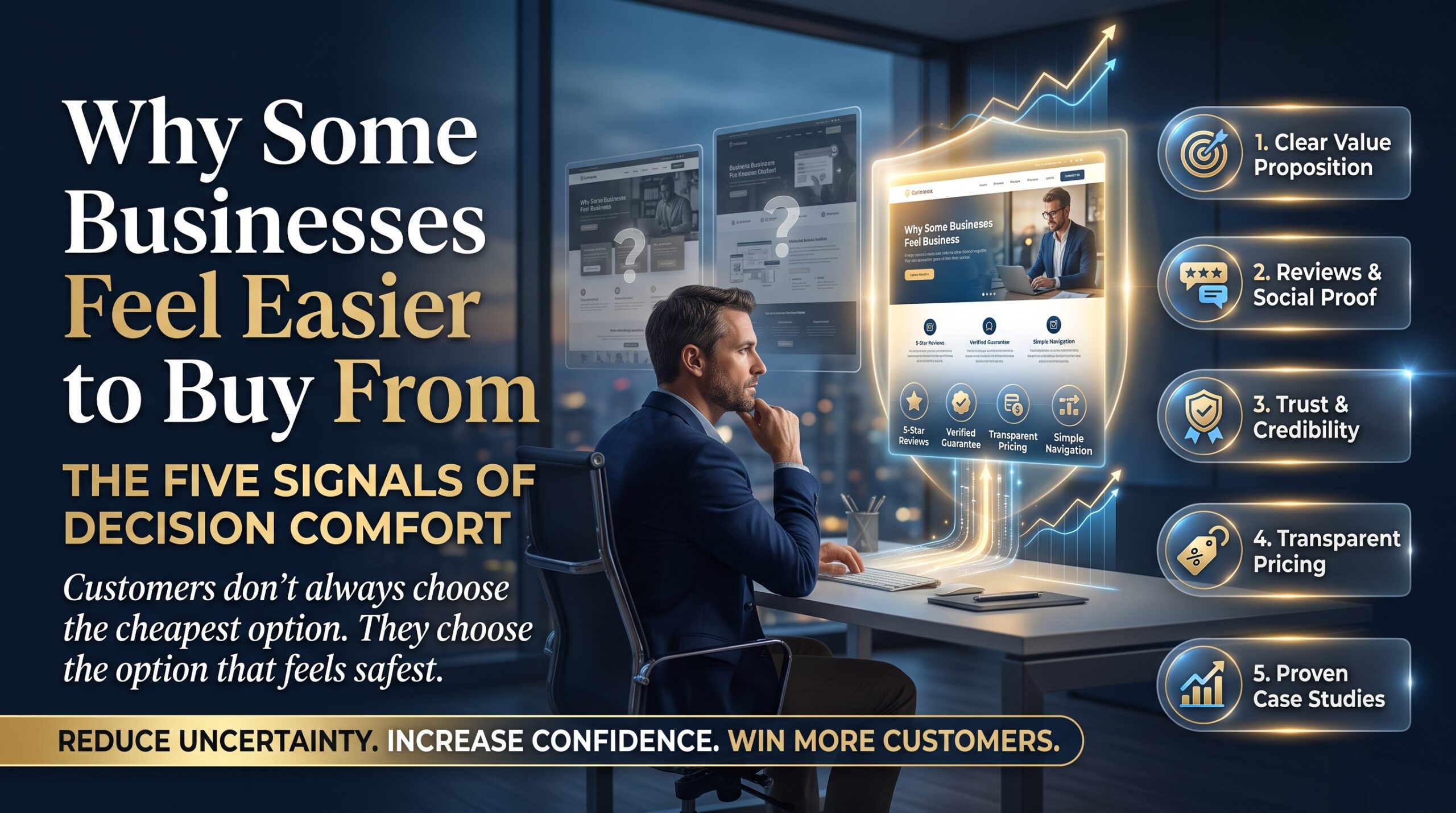
1. Clarity: “I understand exactly what you do”
Confused buyers do not buy. They leave. A clear business explains what it sells, who it is for, what it costs (or how pricing works) and what happens next, all within a few seconds of landing on a page. Vague slogans like “innovative solutions for modern businesses” create friction. Plain language creates decision comfort.
2. Proof: “Other people like me chose you and were happy”
Social proof is one of the strongest levers in persuasion, a point Robert Cialdini made famous in his book Influence. Real Google reviews, named testimonials, before-and-after case studies, industry accreditations and recognisable client logos all tell the visitor they are not the first to take the leap. Proof should be specific. “Great service!” is forgettable. “They fixed our booking system in two days and our enquiries rose by a third” is reassuring.
3. Low Risk: “If it goes wrong, I am protected”
Risk reversal removes the fear of regret. Think free quotes, no lock-in contracts, clear cancellation terms, satisfaction guarantees, transparent reporting and honest timelines. Under Australian Consumer Law, businesses already owe customers certain guarantees, and the ACCC provides plain-English guidance on consumer rights. Businesses that explain their policies openly, rather than hiding them in fine print, make buyers feel safer immediately.
4. Effortless Next Steps: “I know exactly what to do next”
Even a motivated buyer can stall if the path forward is unclear. A short form, a visible phone number, a booking calendar and a single, obvious call to action all make the next step feel small. Research from the Baymard Institute has long shown that average online cart abandonment sits at around 70 per cent, with confusing checkouts, surprise costs and trust concerns among the top reasons. That is a lot of ready-to-buy customers lost to friction, not to price.
5. Consistency: “Everything about you feels reliable”
Buyers cross-check. They compare your website with your Google Business Profile, your social media, your reviews and your ads. When your branding, details, tone and promises line up, confidence rises. When your opening hours differ between platforms or your ad promises something your landing page never mentions, doubt creeps in.
How Decision Comfort Shapes the Way People Search on Google
Decision comfort starts long before someone fills out a form. It begins in the search results. High-intent searches such as “best digital marketing agency in Melbourne,” “trusted SEO services near me” or “Google Ads management cost Australia” show a person who is close to buying but still checking whether they can trust the answer.
Google’s own guidance on creating helpful, reliable, people-first content emphasises experience, expertise, authoritativeness and trust, often shortened to E-E-A-T. In practice, these are trust signals written for a search engine: who wrote this, do they know the subject, can I verify their claims, and is the page safe and easy to use? A business that answers those questions clearly tends to earn both better rankings and better conversion rates.
This is why our SEO services focus on more than keywords. Rankings bring the visit. Comfort decides whether the visit becomes a customer.
How to Build Decision Comfort on Your Website: A Practical Checklist
- Rewrite your homepage headline for clarity. State what you do, who you help and where, in one sentence.
- Show proof above the fold. Add a review snippet, star rating, client logos or a short result next to your main call to action.
- Publish clear pricing guidance. Even a “from” price or a range reduces fear of hidden costs.
- Answer objections before they are asked. Build a proper FAQ page covering timelines, contracts, results and support. See our FAQs for an example.
- Make contact effortless. Use click-to-call on mobile, a short enquiry form and a clear response-time promise.
- Show the people behind the business. An About page with real names, faces and experience builds trust faster than stock photography.
- Fix speed and usability. Slow, clunky pages feel risky. Check your Core Web Vitals in Google Search Console and make sure the site works beautifully on mobile.
- Keep one idea per page. Every page should help the visitor make one decision, not ten.
Decision Comfort in Local Search: Sydney, Melbourne, Brisbane and Beyond
For local businesses, decision comfort often lives in the map pack. A complete Google Business Profile with accurate hours, recent photos, genuine reviews and prompt replies tells searchers you are active and trustworthy before they ever click through to your site.
Local relevance matters too. A buyer searching in Melbourne wants to feel that you understand Melbourne, not just “Australia” in general. Whether you serve customers in Sydney, Melbourne, Brisbane, Adelaide, Perth or Canberra, dedicated location pages with local details, local reviews and local contact options make the choice feel closer to home. You can explore how we support each market on our Locations page.
- Sydney: highly competitive, so differentiation and proof matter most.
- Melbourne: buyers value quality, reputation and consistency across channels.
- Brisbane: strong growth in local services; reviews and fast responses win.
- Adelaide and Perth: less crowded markets where strong local SEO can lead quickly.
- Canberra: professional, research-driven buyers who appreciate detail and credibility.
Decision Comfort in Paid Advertising
Ads that over-promise create discomfort the moment someone lands on your page. Message match is the fix: the promise in your ad should appear almost word for word in your headline, so the visitor feels they are in the right place. Our PPC and Google Ads management approach starts with the landing page experience, because a click you cannot convert is just an expensive visit.
Social platforms work the same way. People rarely buy from a first impression. They notice you, check you out, and come back. Consistent, helpful content through social media marketing keeps your business familiar, and familiarity is a shortcut to comfort.
Seven Decision Comfort Killers to Remove Today
- Hidden or confusing pricing
- No reviews, or reviews that are years old
- Contact forms with too many required fields
- Generic stock photos instead of real people and projects
- Slow mobile pages and broken links
- Mismatched information across your website, Google profile and socials
- Pushy pop-ups and unclear calls to action
Fixing even two or three of these can lift enquiries without spending a cent more on traffic. If you want to see how these issues play out in real campaigns, our blog covers related problems, including why customers ghost businesses they were ready to buy from and the buyer hesitation problem.
A Simple Decision Comfort Audit You Can Run in 15 Minutes
Open your website on your phone and pretend you are a first-time buyer. Then ask these questions honestly:
- Can I explain what this business does within five seconds?
- Do I see proof that real customers are happy?
- Do I know roughly what it will cost, or how pricing works?
- Do I know what happens after I enquire?
- Does anything feel risky, confusing or inconsistent?
Every “no” is a confidence gap. Rank them by effort and impact, fix the quick wins first, and track enquiries, conversion rate and call volume over the following weeks. If you would like an expert second opinion, our team offers a free marketing review for Australian businesses.
Frequently Asked Questions About Decision Comfort
What is decision comfort in marketing?
Decision comfort is the level of confidence and ease a customer feels when choosing a business. It combines clarity, proof, low risk, simple next steps and consistency so the buyer feels safe saying yes.
Why do customers choose businesses that cost more?
Customers often pay more for lower perceived risk. A business with strong reviews, clear communication and a smooth buying process delivers more buyer confidence, which can outweigh a cheaper but less reassuring competitor.
How does decision comfort affect SEO and Google rankings?
Google’s quality guidance rewards experience, expertise, authority and trust. Pages that build this confidence, with clear authorship, honest information and a good user experience, tend to satisfy searchers and perform better over time.
How can a small business improve decision comfort quickly?
Start with your homepage headline, add genuine reviews near your call to action, publish pricing guidance, shorten your contact form and make sure your Google Business Profile matches your website.
Is decision comfort the same as customer trust?
They are closely related. Trust is the belief that a business is reliable. It is broader: it also includes how easy, clear and low-risk the buying process feels.
Can digital marketing agencies help build buyer confidence?
Yes. A good agency aligns SEO, Google Ads, social media and website content so every touchpoint reassures the buyer, from the first search to the final enquiry.
Final Thoughts: Make Choosing You the Easy Choice
Marketing is not only about being seen. It is about being chosen, and people choose what feels safe, clear and easy. Businesses that build it into every touchpoint turn browsers into buyers without discounting, pressure or tricks.
If you are ready to make your business the one customers feel confident choosing, explore our digital marketing services in Australia, or contact our team for a free consultation. We work with businesses across Sydney, Melbourne, Brisbane, Adelaide, Perth and Canberra, and we would love to help you grow.