


Leads but not sales is one of the most frustrating positions an Australian business can be in the phone rings, the enquiry form fills up, and yet revenue doesn’t move. When marketing is clearly generating interest but sales aren’t following, the problem is rarely the marketing channel itself. It’s almost always one of seven specific gaps between the first click and the final “yes.” This guide breaks down each one in plain language, along with exactly how to close it.
If your business is spending on SEO, Google Ads, or social media and still isn’t seeing enough of that traffic turn into paying customers, this is the checklist to work through before changing agencies or increasing ad spend.
7 Reasons Your Marketing Produces Leads But Not Sales
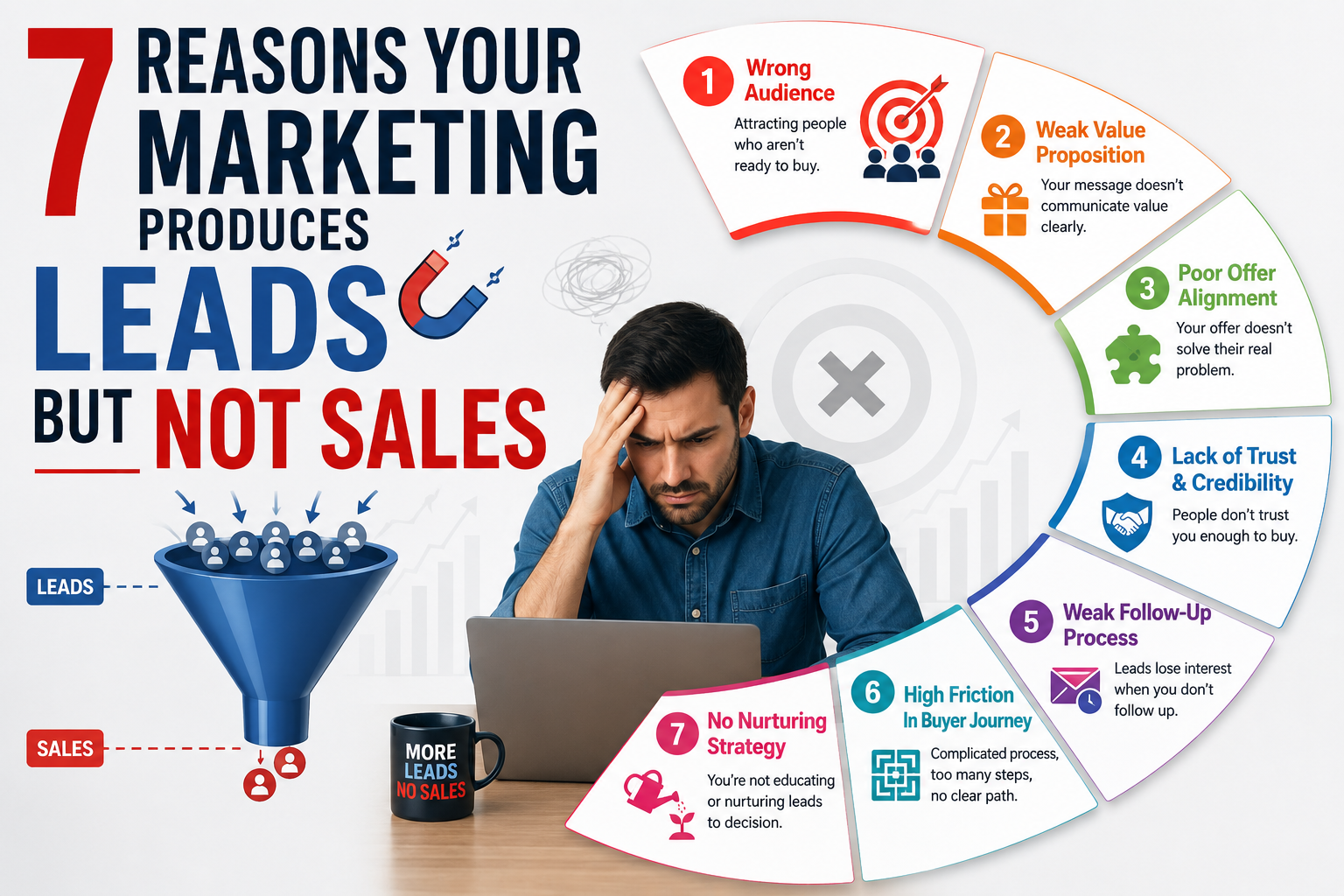
1. Your Marketing Is Attracting the Wrong Audience
The most common reason a business ends up with leads but not sales is that the marketing is pulling in the wrong people. Broad, poorly targeted Google Ads or social campaigns can generate plenty of form fills and phone calls, but if those leads were never a good fit for the product or service, no amount of follow-up will turn them into paying customers.
How to fix it: Tighten targeting around ideal customer profiles: specific job titles, locations, budgets, or buying triggers. Fewer, better-matched leads convert at a far higher rate than a large volume of loosely targeted ones.
2. Slow Response Times Are Losing the Sale
A lead that isn’t contacted within minutes is already cooling off, and by the time a follow-up call happens hours or days later, they’ve often enquired with a competitor instead. This is one of the most fixable causes of leads but not sales, because the marketing did its job — the follow-up process is what let the opportunity slip.
How to fix it: Set up instant notifications for new enquiries, and aim to make first contact within five to ten minutes during business hours. Automated confirmation emails or SMS can hold interest until a real conversation happens.
3. There’s No Lead Nurture Sequence
Not every lead is ready to buy the moment they fill out a form. Without a nurture sequence follow-up emails, retargeting ads, or a simple check-in call schedule businesses end up with leads but not sales simply because interested prospects are never given a reason to come back when they are ready.
How to fix it: Build a basic nurture sequence: a welcome email, a case study a few days later, and a check-in call within two weeks. Retargeting ads can keep the brand visible in the meantime.
4. Marketing and Sales Aren’t Talking to Each Other
When the marketing team doesn’t know which leads actually converted, campaigns keep optimising for lead volume instead of lead quality. This disconnect is a quiet but significant driver of marketing leads not converting, because both teams end up working from different definitions of what a “good lead” looks like.
How to fix it: Share a simple monthly report between marketing and sales that tracks which campaigns and keywords produced leads that actually closed, not just leads that came through the door.
5. The Offer Doesn’t Match What Was Advertised
If an ad promises a fast quote, free consultation, or specific price range and the sales conversation delivers something different, trust breaks down immediately. This mismatch between the marketing message and the actual sales conversation is a direct cause of low lead conversion rate, even when the lead was genuinely interested to begin with.
How to fix it: Audit ad copy, landing pages, and the actual sales script side by side. Make sure the offer, pricing expectations, and next steps are consistent from the first click to the final conversation.
6. There’s No Clear Follow-Up Process for Sales Staff
Even well-targeted, well-nurtured leads fall through the cracks without a defined process for how many times to follow up, when, and through which channel. Businesses relying on memory or ad-hoc follow-up almost always end up with leads but not sales, because some leads simply get forgotten.
How to fix it: Use a simple CRM (even a spreadsheet at a small scale) with a defined follow-up cadence: day 1, day 3, day 7, day 14. Assign clear ownership so no lead is left unaccounted for.
7. Sales Conversations Focus on Features, Not Outcomes
Marketing content is often outcome-focused solving a problem, saving time, reducing cost but sales conversations can drift into a list of features and specifications. When the sales pitch stops matching the reason the lead enquired in the first place, conversion rates drop even for genuinely qualified prospects.
How to fix it: Train sales staff to open every call by restating the specific problem the lead mentioned in their enquiry, then connect the solution back to that outcome throughout the conversation.
What the Research Says
Research from HubSpot on lead response time consistently shows that the speed of first contact is one of the strongest predictors of whether a lead converts, regardless of how well-targeted the original campaign was.
Image Guidance
Add one supporting image (a marketing-to-sales funnel diagram, or an annotated lead-response timeline) with the following:
- File name: leads-but-not-sales-funnel.jpg
- Alt text: leads but not sales funnel diagram
- Placement: directly under the introduction or beside Section 2 (Slow Response Times)
Why This Happens for Businesses Across Australia
The gap between leads but not sales shows up the same way whether a business is based in Sydney, Melbourne, Brisbane, Perth, Adelaide, or Canberra but the competitive pressure differs by city. In fast-moving markets like Sydney and Melbourne, a slow follow-up means a competitor closes the deal within the hour; in Perth and Adelaide, where buyer pools are smaller, a single mishandled lead can represent a meaningful share of a month’s pipeline. Whatever the location, the fix is the same: tighten targeting, speed up follow-up, and keep the sales conversation aligned with the original offer.
Related Pages and Further Reading
Internal links to include naturally within the body copy above (already reflected in the sections where relevant):
- SEO Services
- Google Ads & PPC Management
- Social Media Marketing
- How Much Does Digital Marketing Cost in Australia?
- Google AI Overviews and Australian Businesses
- Contact Us
Frequently Asked Questions
Why am I getting leads but not sales?
It usually comes down to one or more of seven gaps: wrong audience targeting, slow follow-up, no nurture sequence, poor marketing-to-sales handoff, a mismatched offer, no follow-up process, or a sales pitch that doesn’t match the original enquiry.
Is it a marketing problem or a sales problem?
Often both. Marketing controls who enquires and how well-matched they are; sales controls how quickly and effectively that interest is converted. Fixing only one side rarely closes the full gap.
How quickly should a new lead be contacted?
Within five to ten minutes where possible. Response speed is one of the single biggest factors in whether an enquiry turns into a sale.