


Cost of being the second choice rarely shows up on a dashboard. There’s no line item labelled “lost to the competitor buyers preferred.” Instead it shows up as a slightly lower close rate, a slightly higher cost per acquisition, and a sales team that keeps saying “they went with someone else” without ever quite explaining why. If your business is consistently good enough to make the shortlist but not quite good enough to win the deal, you’re not losing on price or product you’re paying the cost of being the second choice, and it compounds every month it goes unaddressed.
What Does It Really Mean to Be the Second Choice?
Being the second choice isn’t about quality most “runner-up” businesses are perfectly capable of doing the job well. It’s about which brand the buyer thought of first, trusted fastest, and felt least risk choosing. Buyers rarely evaluate every option equally; they build a short mental shortlist early, and everything after that is a battle to displace whoever got there first.
Understanding the cost of being the second choice starts with recognising that most of this battle is lost before a prospect ever fills out a contact form. If your marketing isn’t building consideration ahead of the buying moment, you’re guaranteed to be fighting from second place and second place converts at a fraction of the rate of first.
7 Reasons Businesses Quietly Become the Second Choice
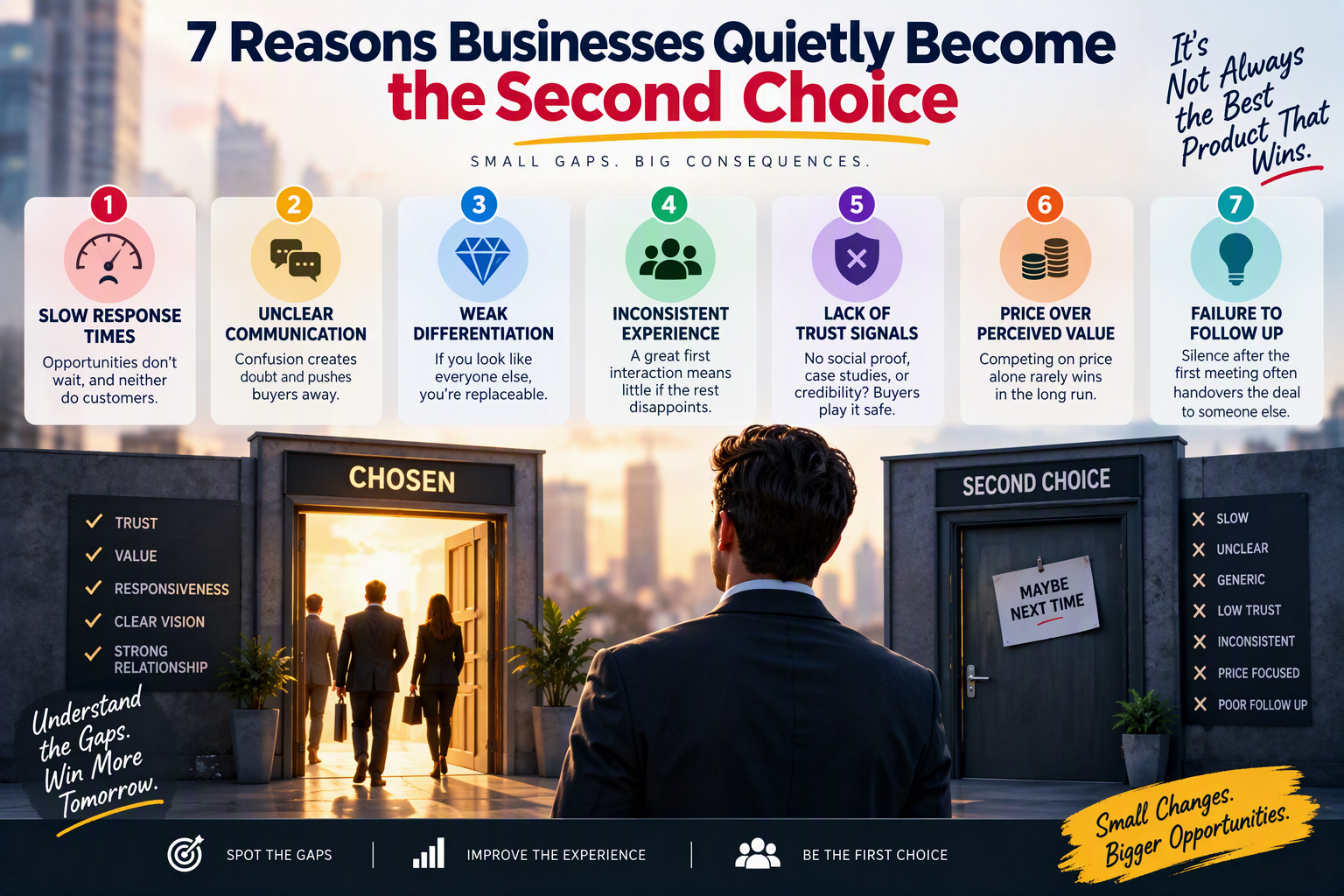
1. Weak Category Presence Before the Buyer Starts Searching
Buyers form preferences long before they search. Research from the LinkedIn B2B Institute shows that most B2B purchase decisions are shaped by brand memory built well before the active buying window opens — if a competitor built that memory first, you start every deal one step behind.
2. Slower Speed to Lead
Even when a prospect considers you first, a faster-responding competitor can flip the decision within hours. Speed to lead is one of the most under-invested areas covered in our Same Marketing Budget guide.
- No clear differentiation. If your messaging reads the same as every competitor’s, buyers default to the name they already trust, not the name that’s technically better.
- Pricing shown without context. Unexplained pricing gets compared on number alone see our Digital Marketing Cost Australia guide for how to frame value instead of just cost.
- Little to no retargeting. Buyers who don’t convert immediately forget you within days without a retargeting sequence to stay top of mind through the decision window.
- Weaker organic and AI-search visibility. If a competitor shows up in Google’s AI Overviews and you don’t, they become the default “safe” answer before the buyer even reaches a website covered in depth in our Google AI Overviews SEO Australia guide.
- Sales follow-up that assumes interest instead of rebuilding it. Generic follow-up emails lose to competitors who tailor their pitch to the specific hesitation a buyer raised — a gap explored further in our Leads But Not Sales guide.
How Much Revenue Second-Choice Positioning Is Actually Costing You
Modelled against typical Australian B2B and service-business conversion benchmarks, here’s where the cost of being the second choice tends to concentrate:
| Stage | Typical Revenue Impact | Root Cause |
| Initial shortlist | 25–35% of prospects never seriously consider you | Weak category presence before active search begins |
| Active comparison | 30–50% of remaining deals | Slower response time or unclear differentiation vs. first choice |
| Post-quote follow-up | 20–30% of quoted deals | No retargeting or tailored follow-up to rebuild consideration |
| Repeat/referral business | 10–20% lost long-term value | Buyer defaults back to their original first choice next time |
Even conservative estimates put second-choice positioning among the largest silent revenue leaks in a growing Australian business — often outweighing inefficiencies in the ad spend itself.
City-by-City: Where Second-Choice Losses Hit Hardest
Competitive density and buyer behaviour both shift the size of this gap by city:
| City | Competitive Pressure | What Wins First-Choice Position Locally |
| Sydney | High dense competitor landscape across most industries | Strong brand presence and fast response time |
| Melbourne | High process-driven buyers compare multiple agencies | Clear differentiation and documented case studies |
| Brisbane | Moderate faster decision cycles favour whoever responds first | Speed to lead and direct relationship-building |
| Perth | Moderate smaller supplier pool, longer buyer memory | Long-term local reputation and referrals |
| Adelaide | Moderate close referral networks | Word-of-mouth and community visibility |
| Canberra | High structured procurement, panel-based decisions | Compliance credentials and category authority |
Action Plan: Moving From Second Choice to First Choice
| Gap | Fix | Where to Start |
| Weak category presence | Build always-on SEO and content authority ahead of active search | SEO Services |
| Slow speed to lead | Automate instant lead response and follow-up sequencing | Google Ads & PPC Management |
| No differentiation | Sharpen messaging around a specific outcome, not generic claims | Social Media Marketing |
| Missing AI-search visibility | Optimise content structure for Google AI Overviews | Google AI Overviews SEO Australia |
How a Full-Service Digital Marketing Partner Fixes This
Beating the cost of being the second choice requires more than a single channel fix it takes consistent SEO, faster-converting ads, and content built to win consideration before the buying moment starts. Our SEO Services, Google Ads & PPC Management and Social Media Marketing work together to build exactly this kind of first-choice positioning for Australian businesses. If second-choice losses sound familiar, get in touch and we’ll map where you’re losing consideration and how to fix it.
Frequently Asked Questions
What is the cost of being the second choice for a business?
It’s the compounding revenue lost when buyers consistently place you second in consideration lower close rates, higher acquisition costs, and lost referral value, even when your product or service is equally strong.
How do I know if my business is the second choice?
Common signs include consistently reaching the final shortlist without winning, sales feedback like “they went with someone else,” and a close rate that’s lower than your quote volume would suggest.
What’s the fastest way to fix second-choice positioning?
Improving speed to lead and adding a retargeting sequence typically produce the fastest measurable lift, followed by sharper differentiation in messaging.
Does SEO really help with this, or is it just about sales speed?
Both matter SEO and AI-search visibility determine whether you’re even part of the shortlist, while speed and follow-up determine whether you win once you’re on it.
Final Word
The cost of being the second choice is one of the most under-diagnosed revenue leaks in Australian business marketing, because it never shows up as a single obvious failure — only as a pattern of near-misses. Fix category presence, speed to lead, differentiation and follow-up together, and the business that was always “good enough” starts becoming the obvious first choice instead.