


Losing customers to competitors is frustrating at the best of times. Losing customers you’ve already paid to attract is a special kind of painful. You funded the ad click, the SEO article, the trade show stand or the referral discount, and then someone else’s name ended up on the invoice. If that keeps happening, your marketing isn’t failing to attract people. It’s failing to keep them.
In this guide we’ll unpack why losing customers to competitors keeps happening even when your marketing looks healthy, where revenue quietly leaks out of a typical Australian sales funnel, and the practical fixes that plug each gap. Whether you run a trades business in Brisbane, a clinic in Sydney or an online store in Melbourne, the pattern is surprisingly consistent.
What losing customers to competitors really costs you
Every customer has an acquisition cost, even when it’s hidden. It’s the ad spend, the agency fee, the hours your team spent on content and the time your salespeople spent on the phone. When someone clicks your ad, browses your services and then buys from a rival, you don’t just miss one sale. You’ve already spent most of the money it takes to win that person, and your competitor collects the reward for a fraction of the effort.
Picture a bath filling with the plug pulled out. Turning the tap on harder (more ad spend) feels productive, but the water level barely moves. Plenty of businesses respond to falling sales by buying more traffic when the smarter move is to fix the plug hole first.
Losing customers to competitors usually happens in the gaps between your marketing channels, not inside them. Your ads might be great and your website might be decent. It’s what happens in between, and afterwards, that decides who gets paid.
Warning signs you’re losing customers to competitors right now
Losing customers to competitors rarely announces itself. It shows up as a slow drift in numbers that look fine until you compare them with what you’re spending. Watch for these signals:
- Ad clicks and website visits are steady, but enquiries are flat or falling.
- Prospects tell you “I went with someone else” or “I got another quote” more often than they used to.
- Your cost per lead keeps climbing while your close rate slips.
- Rivals appear above you in local results or on searches for your own business name.
- Customers who bought once never come back.
If two or more of these sound familiar, you’re almost certainly losing customers to competitors at one or more stages of your funnel. The sections below show you which stage, and what to do about it.
Eight reasons you keep losing customers to competitors (and the fix for each)
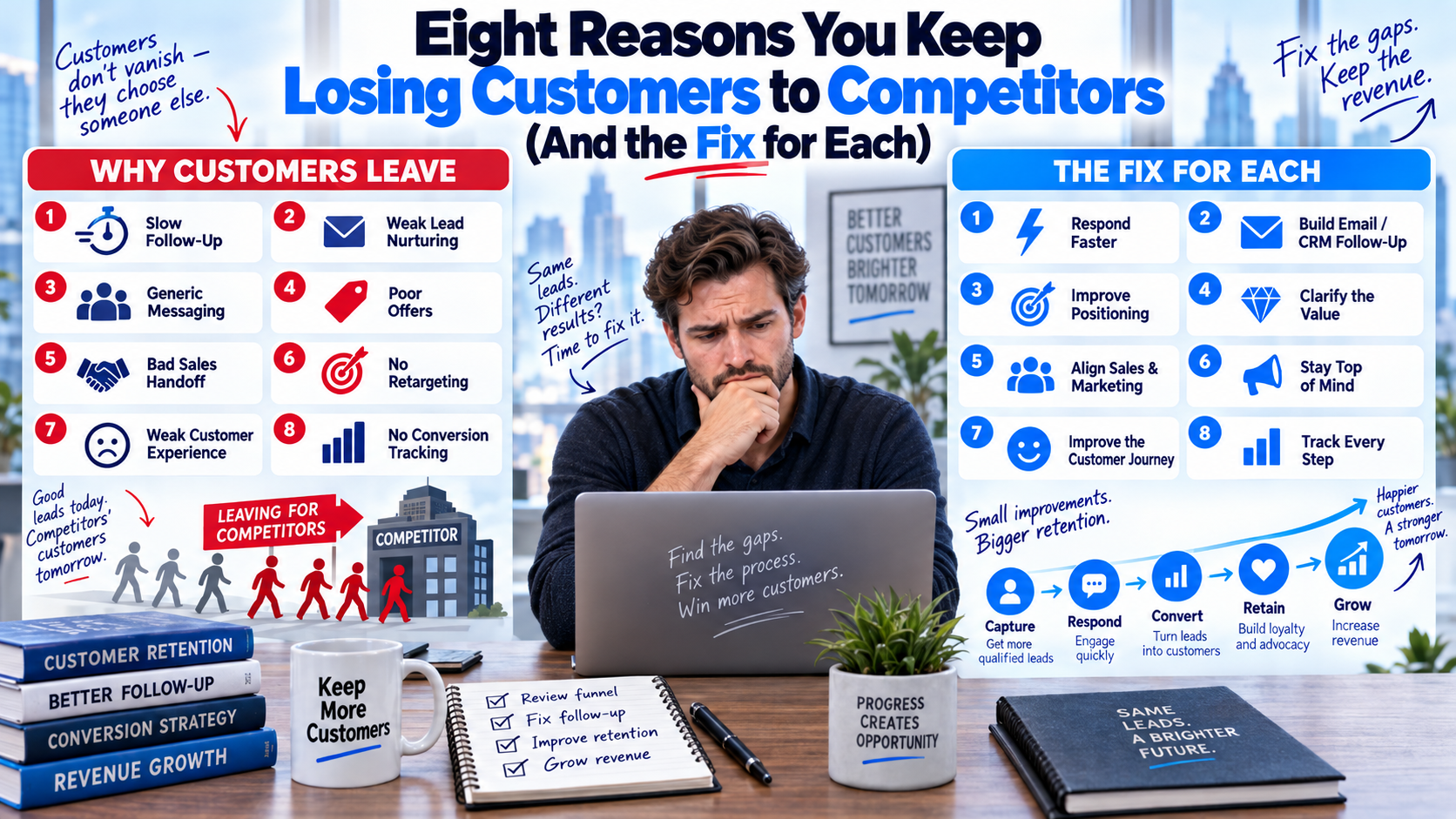
1. You respond too slowly
People shopping for a service rarely contact just one business. They send two or three enquiries and often go with whoever replies first with something helpful. If your form submissions land in an inbox that’s checked twice a day, you’ve handed the sale to the competitor who answered in ten minutes. The fix: set a response-time target, send enquiries straight to a phone that someone actually watches, and use an automatic acknowledgement so nobody waits in silence. Slow follow-up is one of the most common ways of losing customers to competitors, and one of the cheapest to fix.
2. Competitors are bidding on your brand name
Search for your own business name on your phone. If a rival’s ad appears above your listing, they’re intercepting people who were already looking for you. Competitors can often bid on your brand name as a keyword, which means your warmest searchers may also be the easiest to steal. The fix: run a low-cost brand campaign in Google Ads so your name owns the top of the page, and check Google’s current trademark policy for what rivals are allowed to say in their ad text.
3. You never follow visitors who leave
Most visitors won’t enquire on their first visit. That’s normal. What isn’t normal is letting them wander off while your competitor’s ads follow them around the internet. Every visitor you let drift away is another route to losing customers to competitors. The fix: set up remarketing (also called retargeting) so people who viewed your services see helpful reminders, offers and proof points across search, social and display.
4. Your website makes it hard to say yes
Slow loading, cluttered menus, vague headlines and hidden contact details quietly push people back to the search results, where a rival is waiting. Mobile visitors are especially unforgiving. The fix: make one clear next step obvious on every page, trim load times, put your phone number and reviews near the top, and use conversion optimisation to test changes instead of guessing.
5. Your local reputation is weaker than theirs
People compare star ratings, review counts and recent comments before they compare prices. A competitor with 200 recent reviews will often beat you with 20, even if your work is better. The fix: complete and maintain your Google Business Profile, ask happy customers for reviews as part of your normal process, reply to every review politely, and follow the ACCC’s guidance on online reviews so everything you publish stays genuine.
6. Leads go cold because nobody nurtures them
Not everyone is ready to buy on day one. Someone who asks for a quote today might need three weeks to decide. If your only follow-up is a single email, you’re leaving the timing to your competitor. The fix: build a simple nurture sequence with email marketing and SMS that shares useful content, answers common objections and explains what happens next. Keep it compliant with the Spam Act rules explained by ACMA, which cover consent, sender identification and a working unsubscribe.
7. You forget your past customers
Existing customers are usually the cheapest people to sell to, yet many businesses stop talking to them the moment the invoice is paid, which is a surprisingly costly way of losing customers to competitors. A quiet customer is an easy target for the next competitor with a friendly offer. The fix: set up post-purchase emails, service reminders, loyalty offers and a win-back campaign for people who haven’t bought in a while.
8. You can’t see where the leaks are
If you don’t trace calls, forms, chats and sales back to their source, you’re guessing. Many businesses discover that their best-looking campaign generates enquiries that never turn into revenue, or that a chunk of their phone calls go unanswered. The fix: connect Google Analytics to your CRM, add call tracking and build a simple dashboard showing cost per lead, lead-to-sale rate and revenue by channel.
A familiar scenario: you paid for the click and lost the booking
Imagine a Sydney physiotherapy clinic spending a few thousand dollars a month on Google Ads. A prospect searches, clicks, browses the treatments page and submits a form at 6.30 pm. The form email sits unread until the next morning. Meanwhile, a competitor two suburbs away has an after-hours auto-reply, an online booking link and 150 recent reviews. By the time the clinic phones back at 9 am, the prospect has already booked elsewhere.
Nothing was wrong with the ad, the clinic or the price. The clinic simply fell into losing customers to competitors through a gap nobody was watching. (This scenario is illustrative, but service businesses in every city will recognise the pattern.)
A 15-minute audit to find where you’re losing customers to competitors
You don’t need a big project to spot what’s behind losing customers to competitors. Open your last month of enquiries and check these eight warning signs.
| Leak | Warning sign | Quick fix |
| Slow response | Enquiries wait hours for a reply | Instant alerts and a response-time target |
| Brand hijacking | Rival ads show on your name | Brand search campaign |
| No remarketing | Visitors never see you again | Remarketing audiences on Google and Meta |
| Website friction | High bounce rate, low form completions | Clear call to action, faster pages |
| Weak reputation | Fewer or older reviews than rivals | Review requests and replies |
| No nurture | One follow-up, then silence | Email and SMS sequence |
| No retention | Past customers never hear from you | Win-back and loyalty campaigns |
| Blind spots | Can’t say which channel makes sales | Tracking, CRM and reporting |
Then try a quick calculation. Say your business receives 200 enquiries a month and closes 20 per cent. That’s 40 customers. If faster follow-up and better nurturing lift your close rate to 25 per cent, you win 10 extra customers every month from traffic you’ve already paid for. (These numbers are illustrative, so swap in your own.) It’s often the cheapest growth available to you.
A 90-day plan to stop losing customers to competitors
Fixing everything at once isn’t realistic. Work through the leaks in order of speed and impact.
- Days 1 to 14: measure the leaks. Set up tracking, check how quickly you respond to enquiries, review your brand search results and list where prospects stall.
- Days 15 to 30: grab the quick wins. Switch on instant enquiry alerts, launch a brand campaign, add click-to-call buttons and start asking for reviews.
- Days 31 to 60: build the safety net. Create remarketing audiences, write nurture emails and SMS messages, and improve your top landing pages.
- Days 61 to 90: test and improve. Trial new headlines, offers and forms, launch a win-back campaign for past customers and compare revenue by channel.
- Ongoing: review monthly. Move budget towards what actually produces sales, not just clicks.
Research libraries such as Think with Google are useful for understanding how people research and compare options online, which helps you decide where your follow-up needs to be strongest.
Mistakes that make losing customers to competitors more likely
- Raising ad budgets before fixing follow-up. More traffic into a leaky funnel just means more expensive leaks.
- Judging campaigns by clicks and impressions. Revenue and lead-to-sale rate tell the real story.
- Running every channel as a separate project. Disconnected goals create disconnected customer experiences.
- Ignoring or arguing with negative reviews. A calm, helpful reply is read by every future prospect.
- Only marketing to new customers. The people who already trust you are your best chance of repeat revenue.
Which digital marketing services plug which leak?
Each channel plugs a different hole, and they work best together. That’s why buying channels in isolation so often disappoints when the goal is to stop losing customers to competitors. An integrated set of digital marketing services lets your ads, website, email and reporting share the same goal: turning the attention you’ve paid for into revenue.
- SEO and local SEO: helps you appear where people compare options and strengthens the reputation signals that decide close calls. See our SEO services.
- PPC and Google Shopping: protects your brand name, powers remarketing and puts your products in front of ready-to-buy shoppers. See our PPC advertising.
- Conversion optimisation: removes friction from your website so more visitors become enquiries.
- Email marketing and automation: nurtures leads and keeps past customers coming back.
- Social media: keeps you visible between purchases and supports remarketing. See our social media marketing.
- Analytics and transparent reporting: shows exactly where money is made and where it leaks.
Digital marketing services in Melbourne, Sydney, Brisbane and beyond
Our dedicated teams are based in Melbourne, Sydney and Brisbane, and we work with businesses right across Australia. The same leaks behind losing customers to competitors tend to appear everywhere, but they show up a little differently in each market.
- Melbourne: crowded local search for trades, health and professional services, so reputation and brand protection matter.
- Sydney: paid search can be expensive, so every wasted click hurts and tracking becomes essential.
- Brisbane: a fast-growing service market where local SEO and strong reviews often decide who gets the call.
Not sure which of your leaks is costing you the most? Book a strategy session and we’ll map your funnel from first click to final sale.
Common questions about losing customers to competitors
Why do customers choose my competitor after visiting my website?
The usual causes of losing customers to competitors after a website visit are simple: the rival was quicker to respond, easier to trust or easier to contact. Price matters less than most owners expect when speed, reviews and clarity are missing.
How fast should I respond to a new enquiry?
As fast as you realistically can. Minutes beat hours, and hours beat days. Set a target, measure it weekly and automate the first reply so people know you’ve received their message.
Is it legal for competitors to bid on my brand name?
In many cases competitors can bid on your brand name as a keyword, although Google’s trademark policy limits what they can say in ad text. Check Google’s current policy, and speak to a lawyer if you believe your trademark is being misused.
How long does it take to stop losing customers to competitors?
Quick wins such as faster follow-up and a brand campaign can show results within weeks. SEO, reviews and retention programs build over months, so treat them as long-term assets.
Should I spend more on ads or fix my funnel first?
Fix the funnel first. Extra ad spend on a leaky funnel simply pays for more lost customers. Once your follow-up, website and tracking are working, scaling spend becomes far safer.
Final thoughts: stop losing customers to competitors for good
Winning attention is only half the job. The businesses that grow consistently are the ones that protect every enquiry they’ve paid for, follow up quickly, stay visible after the first visit and look after customers once the sale is done. Plug the leaks and your existing marketing budget works harder without another dollar of ad spend.
Ready to stop losing customers to competitors? Explore our digital marketing services or get in touch to talk about your goals.