


Your traffic numbers look fine. People are landing on your site, browsing a few pages, even adding items to a cart and then buying from a competitor instead. Why customers visit your website but buy from competitors almost never comes down to price. It comes down to trust. This article breaks down exactly where that trust gap forms, and how the right digital marketing services close it.
What the Trust Gap Actually Is
The trust gap is the space between a visitor being interested in what you offer and actually feeling confident enough to hand over their money or contact details. Traffic gets someone to your website. Trust gets them to convert. A business can have excellent products, competitive pricing and strong ad targeting, and still lose the sale in that gap because the website itself failed to build enough confidence in the moments that mattered.
Why Customers Visit Your Website But Buy From Competitors
In almost every case we see, it’s one or more of the same handful of trust signals missing or weak not the product, not the price, and often not even the marketing that brought the visitor there in the first place.
1. Weak or Inconsistent Design Signals
Visitors form a credibility judgement about a website within seconds, largely based on visual design quality alone. A dated layout, inconsistent fonts, or a cluttered homepage silently signals “this business might not be reliable” even if the underlying business is completely trustworthy.
2. Missing or Buried Social Proof
Reviews, testimonials and case studies do real work. A visitor comparing you against a competitor with visible five-star reviews and client logos will often choose the competitor by default, simply because the proof is easier to find and easier to trust.
3. Unclear or Hidden Pricing
Forcing visitors to “contact us for pricing” when a competitor shows clear, transparent pricing creates friction at exactly the point a buying decision is being made. Some hidden-pricing models make sense for complex B2B sales, but for most businesses, unclear pricing simply pushes the visitor to a competitor’s site to compare.
4. Slow Load Times and Poor Mobile Experience
According to research from the Baymard Institute, complicated or frustrating checkout and browsing experiences are consistently one of the biggest reasons visitors abandon a purchase, even after showing clear buying intent. A slow, clunky mobile experience does the same thing before a visitor even gets that far.
5. No Clear Next Step
A homepage without an obvious next action a clear call-to-action, a simple enquiry path leaves visitors to figure it out themselves. Most won’t bother. They’ll simply go back to search results and click the next result instead, often a competitor with a clearer path to action.
6. Thin or Generic Content
Vague, templated copy that could describe any business in the industry doesn’t build trust it builds doubt. Visitors are quietly asking “do these people actually understand my situation,” and generic content answers no.
How Competitors Win With the Same Marketing Budget
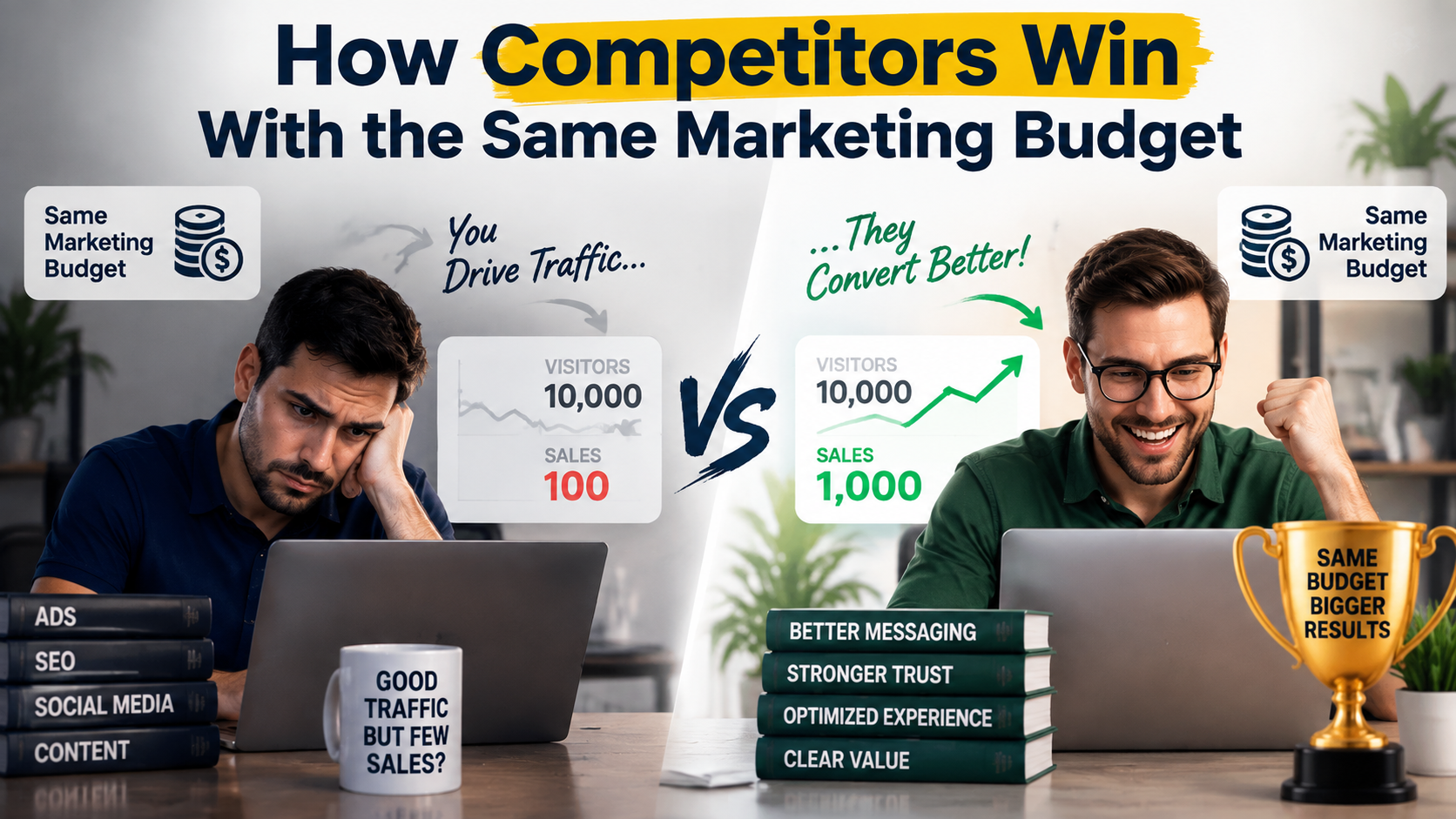
It’s rarely about outspending you. Competitors who convert better are usually just removing more friction and building more visible trust at every step clearer pricing, stronger social proof, a faster site, and a more obvious next step. The traffic you’re both paying for behaves very differently once it lands on two websites with a different level of trust built in.
How to Close the Trust Gap
- Add visible, specific social proof reviews, testimonials, real client results
- Make pricing as transparent as your business model allows
- Fix load speed and mobile experience before increasing ad spend further
- Give every page one clear, obvious next step
- Replace generic copy with specific, credible detail about your business and results
- Keep business information (name, address, phone) consistent everywhere online
Why This Matters More As AI Search Grows
Research from the Nielsen Norman Group has long shown that users judge website credibility largely on design quality and clarity within seconds of arriving and that same first impression now also shapes whether AI search tools treat your site as a trustworthy source worth citing. A weak trust signal doesn’t just lose you a sale directly on your site anymore; it can quietly remove you from consideration before a customer even lands there.
Where This Trust Gap Shows Up Most Across Australia
We consistently see this pattern with businesses across Sydney, Melbourne, Brisbane, Adelaide, Perth and Canberra strong SEO and PPC campaigns bringing in solid traffic, while the website itself quietly leaks a share of those visitors to competitors with a more trustworthy-feeling site.
Common Mistakes That Widen the Trust Gap
- Focusing all budget on traffic generation and none on conversion or trust
- Copying competitor messaging instead of showing specific, credible proof
- Treating reviews and testimonials as optional rather than essential
- Ignoring page speed and mobile experience while chasing more clicks
- Making visitors work to find pricing, contact details, or next steps
Final Thoughts
If you’ve been wondering why customers visit your website but buy from competitors, the traffic was never the problem the trust gap was. Closing it usually means combining stronger social media marketing for visible proof, sharper SEO for the right kind of traffic, and a website that actually earns the click it’s paid for. Request a free marketing review to see exactly where your trust gap is costing you sales.