


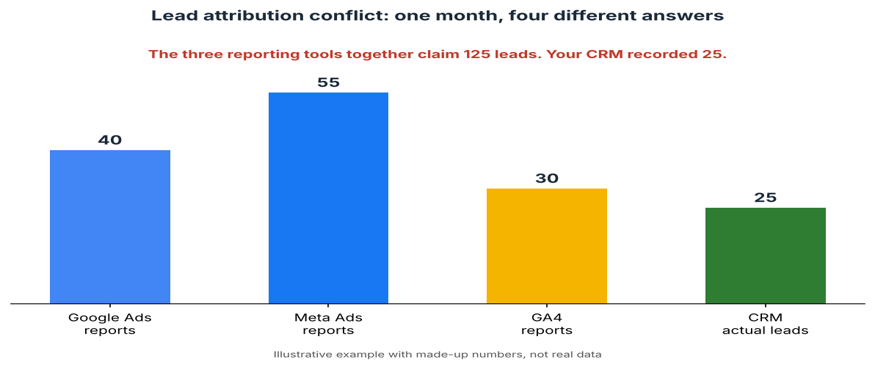
Lead attribution is the reason a marketing meeting can turn awkward in under five minutes. Google Ads says it generated 40 leads last month. Meta says it generated 55. Google Analytics shows 30. And your CRM, the system your sales team actually works from, recorded 25. Add them up and the platforms are claiming credit for five times more leads than your business received. Everyone has a dashboard, everyone has a number, and nobody agrees.
This is the lead attribution conflict, and it affects almost every Australian business that advertises across more than one channel. It isn’t a sign that your agency is hiding something or that your tracking is hopelessly broken. It happens because each system counts differently, for different reasons, with different rules. This guide explains why the numbers disagree, which ones to trust for which decisions, and how to build a reporting setup that your marketing team, your sales team and your finance team can all rely on.
What Is Lead Attribution?
Lead attribution is the process of deciding which marketing activity deserves credit for a lead or sale. A customer might see a Meta ad on Monday, search your brand on Google on Wednesday, click a Google ad on Friday and fill in a form. Which channel produced that lead? The answer depends on the rules you apply, and different tools apply different rules. You can read a broader overview on the marketing attribution) page.
The key point is that attribution is a model, not a measurement. It’s a set of assumptions about how credit should be shared. Two tools looking at identical customer behaviour can legitimately produce different answers, because they started from different assumptions.
Why Google, Meta and Your CRM Report Different Results
There are several overlapping reasons why lead attribution differs between tools. In most businesses, more than one of them is at work at the same time.
1. Each platform marks its own homework
Google Ads and Meta Ads are both designed to show you how well your advertising is working, so each one counts any conversion it can reasonably link to its own ads. Neither checks what the other is claiming. If a customer clicked a Google ad and also saw a Meta ad, both platforms may report the same lead. Add the numbers together and you’ve counted that one person twice. It is the biggest single source of lead attribution inflation.
2. They use different attribution models and windows
A model decides how credit is shared among touchpoints, and a window decides how long after an ad interaction a conversion still counts. Google Ads and Google Analytics 4 commonly use data-driven attribution, which distributes credit using machine learning. Meta applies its own windows for clicks and views. A tool that counts views as well as clicks will almost always report more conversions than one that counts clicks alone.
3. “Lead” doesn’t mean the same thing everywhere
In Google Ads, a lead might be a form submission. In your CRM, it might be a contact record that sales has accepted as genuine. Spam, duplicates, existing customers and wrong-number enquiries may count as conversions in an ad platform and be removed from the CRM. When definitions differ, the totals will too.
4. Tracking is incomplete
No tracking setup captures everyone. Visitors who decline cookies, use ad blockers or browse on privacy-focused browsers and devices may not be tracked in full. In Australia, privacy expectations and consent practices continue to shape what can be collected, and the OAIC provides guidance on privacy obligations. Platforms try to fill the gaps with modelled conversions, which are estimates rather than direct observations.
5. Customers don’t stay on one device or channel
A person might research on their phone, then fill in a form on a laptop. They may phone you after seeing an ad, never visit the website again and never trigger a tracked conversion. Some of the most valuable leads, such as phone calls and walk-ins, arrive through routes that ad platforms can’t see.
6. Dates and time logic differ
Some tools record a conversion on the date of the ad click, others on the date the conversion happened. Reports may be updated after a delay, and different tools can use different time zones. Comparing a Monday-to-Sunday report in one tool with a calendar-month report in another will rarely match.
7. The CRM has its own problems
The CRM isn’t automatically perfect. Source fields can be overwritten when a lead returns through another channel. Missing UTM tags may leave sources blank. Sales staff sometimes change the lead source by hand, or choose the first option in a drop-down list. If the tracking details never reach the CRM, it can’t tell you where the lead came from.
Who Is Counting What? A Quick Comparison
| Source | What it typically counts | Common bias to watch |
| Google Ads | Conversions linked to Google ad interactions. | Counts credit for its own ads and may include low-quality or duplicate form fills. |
| Meta Ads | Conversions linked to Facebook and Instagram ad clicks and, depending on settings, views. | Includes view-based credit, so totals can be higher than click-only tools. |
| Google Analytics 4 | Key events across all channels based on its own model. | Depends on consent and tag setup, so some visits are missing. |
| CRM | Leads and sales recorded by your team and forms. | Source data may be missing, overwritten or entered by hand. |
Notice that none of them is lying, because lead attribution differences are rarely about honesty. Each is answering a slightly different question. The mistake is treating them as if they were answering the same one.
The Real Cost of the Lead Attribution Conflict
A lead attribution conflict isn’t only an irritation. It leads to costly decisions:
- Budget goes to the loudest channel. Whichever platform reports the most conversions tends to win more spend, even if it isn’t producing the most revenue.
- Good channels get cut. Channels that start the customer journey, such as social or content, often look weak in last-click reports and get defunded.
- Agencies and teams argue instead of improving. Time spent debating numbers is time not spent improving campaigns.
- Leadership loses trust. When the marketing report never matches the sales report, executives stop believing either.
- Return on ad spend is misjudged. You can’t work out the real cost per lead or per sale if the lead count is inflated.
If your marketing seems to produce plenty of leads but few sales, the attribution problem may be part of the explanation. Our article on why your marketing generates leads but not sales explores the other half of that story.
Warning Signs You Have a Lead Attribution Problem
Here are the common symptoms of a lead attribution problem:
- The leads reported by ad platforms add up to far more than your CRM shows.
- Nobody can say which number is the official one.
- Lead source fields in the CRM are blank, “Other” or “Unknown” for a large share of records.
- Reports from your agency, your analytics tool and your sales team never reconcile.
- Spend decisions change every month depending on whichever dashboard was opened last.
- Phone calls and offline enquiries don’t appear in any marketing report.
How to Fix Lead Attribution: A Practical Plan
Fixing lead attribution doesn’t mean making every tool agree, and you shouldn’t try. The goal is to agree on which system answers which question, and then make the data flow between them cleanly. Here is a plan most Australian businesses can follow:
- Agree on what a lead is. Write a single definition, for example a qualified enquiry that sales accepts, and use it everywhere. Separate raw enquiries from qualified leads and from sales.
- Make the CRM the system of record. Treat your CRM as the source of truth for leads and revenue. Ad platforms tell you how their ads are performing, and analytics tells you how people behave on your site, but the CRM should settle what actually happened.
- Use consistent UTM tags. Tag every campaign link with a standard naming convention. UTM parameters tell your tools which campaign, source and medium brought each visit.
- Pass tracking details into the CRM. Capture click identifiers and UTM values in hidden form fields, so each lead record carries its original source and campaign.
- Send CRM outcomes back to the platforms. Import qualified leads and sales back into Google Ads and Meta, using methods such as offline conversion imports and the Conversions API, so the ad platforms learn from real results rather than raw form fills.
- Strengthen your tracking. Use Google Tag Manager, enhanced conversions and consent settings that match your privacy obligations, to recover as much measurement as you can legitimately collect.
- Track phone calls and offline leads. Use call tracking or ask staff to record the source consistently, so the leads that ads can’t see still appear in your reports.
- Ask customers how they found you. A simple “How did you hear about us?” field catches influences that tracking misses, such as word of mouth and podcasts.
- Reconcile monthly. Compare platform numbers with CRM numbers on a regular schedule, explain the gaps and track whether they narrow over time.
- Test what actually works. Where budgets are large enough, use holdout tests or other incrementality methods to find out whether a channel truly adds leads that wouldn’t have arrived anyway. Larger advertisers may also use marketing mix modelling.
- Report ranges, not false precision. Show leadership a clear primary number from the CRM and explain that platform figures are supporting evidence.
A Simple Monthly Reconciliation Routine
A short routine, done consistently, improves lead attribution quickly. Try this layout:
| Step | What to compare | What to do with the gap |
| 1. Platform totals | Leads reported by Google Ads, Meta and other channels. | Note them, but don’t add them together. |
| 2. Analytics total | Key events recorded in GA4 for the same period. | Check the dates, time zone and event definitions match. |
| 3. CRM total | Qualified leads created in the same period. | Treat this as the number to report to leadership. |
| 4. Gap analysis | Differences between the platform and CRM totals. | Explain them with duplicates, spam, missing tags and offline leads. |
| 5. Actions | Items that would narrow the gap next month. | Assign an owner and a deadline for each. |
Which Number Should You Trust?
When it comes to lead attribution there’s no single number for every question, but a sensible rule of thumb is to match the question to the source:
- How many real leads and sales did we get? Trust the CRM.
- Which ads, audiences and keywords should I adjust inside a platform? Use that platform’s own reporting, because it has the most detail about its own ads.
- How do visitors behave on our website? Use analytics.
- Is this channel truly adding customers? Use incrementality tests and trends over time, not any single dashboard.
Help for each tool is available directly from Google Analytics Help and Meta Business Help, and it’s worth checking their current documentation, since platform settings and defaults change from time to time.
Digital Marketing Services That Support Accurate Attribution
Good lead attribution depends on good fundamentals: sound tracking, well-structured campaigns and clear reporting. Our team helps Australian businesses build all three across the main channels:
- Digital marketing services for a joined-up strategy where channels are measured consistently.
- SEO services that attract high-intent organic traffic and measure its contribution properly.
- PPC and Google Ads management with conversion tracking set up around real business outcomes.
- Social media marketing with clear reporting that doesn’t overclaim credit.
If your conversion numbers never seem to match, you may also find our articles on converting the traffic you’re paying for and the buyer hesitation problem useful. You can also browse the full blog.
Digital Marketing Support Across Australia
We work with businesses across Australia, from local service providers to national brands. Find your city below:
- Digital marketing in Melbourne, with an office in West Melbourne.
- Digital marketing in Sydney, with an office in Surry Hills.
- Digital marketing in Brisbane, with an office in Brisbane City.
- Digital marketing in Perth
- Digital marketing in Adelaide
- Digital marketing in Canberra
You can also see all locations, learn more about us, read the FAQs, or contact our team on 1300 649 299 to request a free marketing review.
Frequently Asked Questions About Lead Attribution
What is lead attribution?
Lead attribution is the method used to decide which marketing channels and campaigns get credit for generating a lead. Different tools use different rules, so they often give different answers for the same leads.
Why does Google Ads show more conversions than my CRM?
Google Ads counts conversions it links to its own ads, which can include duplicates, spam and enquiries your sales team later rejects. The CRM usually shows only the leads that were accepted or created, so its total is generally lower.
Why do Meta and Google both claim the same lead?
Each platform reports conversions it can connect to its own ads and doesn’t check what other platforms are claiming. A customer who interacted with both can be counted by both, which makes the combined total higher than reality.
What is the difference between last-click and data-driven attribution?
Last-click gives all the credit to the final interaction before the conversion. Data-driven attribution spreads credit across several interactions using a statistical model. Neither is perfect, and they can produce very different channel results.
Which attribution model is best?
There isn’t one that suits everyone. For lead attribution, choose a model that fits how your customers buy, use it consistently and check it against your CRM. For important budget decisions, supplement any model with incrementality testing.
How can I fix mismatched lead data?
Agree a lead definition, use the CRM as the system of record, tag campaigns consistently, pass source data into the CRM, send CRM outcomes back to ad platforms and reconcile the numbers every month.
Final Thoughts on Lead Attribution
When Google, Meta and your CRM disagree, it can feel like someone must be wrong. In most cases, nobody is. They are simply measuring different things in different ways. Lead attribution gets easier the moment you stop expecting every dashboard to match and start deciding which system answers which question.
The businesses that handle it well treat the CRM as the source of truth, feed good data back to the platforms and reconcile the numbers regularly. If you’d like help building a measurement setup you can trust, explore our digital marketing services in Australia or contact our team today.