


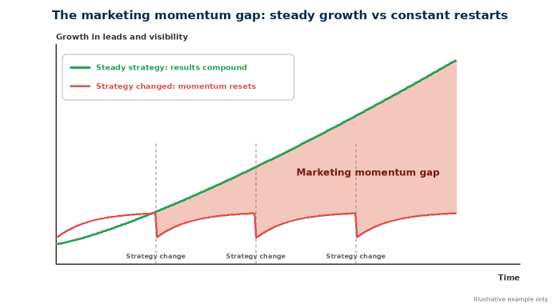
The marketing momentum gap is the growth a business loses every time it abandons one marketing plan and starts another. It usually goes like this. A company launches an SEO project, gets nervous after six weeks, switches to social media, then jumps to paid ads, then hires a new agency with a brand-new approach. Each change feels like action. Each one quietly resets the clock, and the business never reaches the point where marketing starts to compound.
This guide explains why the marketing momentum gap happens, what research and platform guidance say about how long marketing takes to work, when changing direction is genuinely the right call, and how to build a steadier plan. It also shows how the SEO, social media and Google Ads services at Digital Marketing Services support long-term growth across Australia.
Quick answer: businesses lose growth when they change strategy because most digital marketing channels build results over months, not weeks. Every restart throws away learning, data, audience trust and ranking progress. You close the marketing momentum gap by setting a 12-month plan, deciding in advance what evidence would justify a change, changing one thing at a time and keeping your foundations running while you test new ideas.
What Is the Marketing Momentum Gap?
The marketing momentum gap is the difference between the results a consistent strategy would produce and the results a constantly changing strategy actually delivers. It is not about refusing to adapt. It is about the hidden cost of starting over before earlier work has had time to pay off.
Think of pushing a heavy flywheel. The first turns take real effort and show little movement. Once it is spinning, each push adds to the speed already there. If you stop and walk away to try a different flywheel, you lose all that stored energy and have to begin again from nothing.
Why Businesses Lose Growth Every Time They Change Strategy
The marketing momentum gap is created by several effects that stack together. Understanding them makes it easier to resist the urge to start again.
1. The best channels compound slowly
SEO and content marketing are slow to start and powerful once they build. Google’s Maile Ohye is quoted in a PWD guide to why SEO takes so long as saying SEOs typically need four months to a year to implement improvements and see measurable results. The same guide cites an Ahrefs poll of more than 3,600 SEO professionals in which 58% said meaningful progress takes three to six months and 19% said seven to twelve months. Kerry Jones, writing for MarTech, says in this article on the content marketing benefit worth waiting for that SEO gains usually take six months to a year to become significant, and that traffic can keep arriving long after content is published. A business that changes direction every quarter never collects that payoff, and the marketing momentum gap keeps widening.
2. Paid campaigns have learning periods
Google Ads uses a learning period after certain structural changes. According to Google’s help page on the Smart Bidding learning period, the status lasts at most seven days, and performance usually takes one to two conversion cycles to settle. Triggers include creating or reactivating a bid strategy, adding or removing campaigns, ad groups or keywords from a bid strategy, and significantly changing conversion goals. Routine adjustments such as budgets, targets, creatives and targeting settings do not trigger it. The lesson is not that you can never touch a campaign. It is that big structural changes have a real cost, so make them deliberately.
3. Audience trust and recognition reset
Customers rarely buy after one message. Brick Marketing’s president, Nick Stamoulis, argues in this article on stopping marketing that consistency builds trust, especially in B2B where sales cycles are long. A new tone, new look and new channel every few months makes it harder for people to remember who you are.
4. Data and learning get thrown away
Every strategy change that comes with new tracking, new campaign names or a new website can break your comparison data. Without a stable baseline, you cannot tell what is working, so the next decision is a guess.
5. Stop-start effort slows progress
The Brick Marketing article notes that results typically start to slip within a few months of pausing, and that restarting does not restore the previous level straight away. The EngageWeb piece on impatience in SEO makes a related point: changing direction before earlier work has had time to take effect can undermine progress, and publishing content in occasional large batches helps less than a steady schedule.
6. Team and agency churn
When a new agency or a new marketing manager arrives, they often want to start fresh. Knowledge about what the audience responds to, which keywords matter and what has already failed walks out of the door.
7. Judging the strategy on the wrong timeline
A business that expects a slow-building channel to behave like an instant one will always be disappointed. The strategy gets blamed when the expectation was the problem.
Is Changing Strategy Ever the Right Move?
Yes. Staying the course is not the same as ignoring evidence. Some situations justify a real change: the channel has had enough time and enough budget and still shows no leading signals, customer behaviour has shifted, your offer or market has changed, or a technical problem is blocking results. The skill is telling the difference between a pivot that the evidence supports and a panic reaction to a slow month that only widens the marketing momentum gap.
| Keep going and refine | Consider a real change |
| Early signals are improving, such as impressions, engagement and enquiries | No leading signals after a fair test period and adequate investment |
| Results are slower than hoped but trending the right way | Tracking shows the channel attracts the wrong audience |
| A competitor launched something new | Your product, pricing or target customer has changed |
| You are bored with the creative | Technical problems are blocking progress and cannot be fixed |
| Leadership wants to try something trendy | Data from at least a full test cycle points to a better option |
The Hidden Cost of the Marketing Momentum Gap
The marketing momentum gap rarely shows up as a line on a budget. It hides in lost opportunity:
- Wasted spend: money invested in setup, content and learning that never gets used.
- Slower lead growth: each reset pushes the compounding benefits further away.
- Higher acquisition costs: you keep paying to reach people instead of building assets that attract them.
- Confused customers: inconsistent messaging weakens your brand.
- Team fatigue: people stop believing the new plan will last.
Signs You Have a Marketing Momentum Gap
Wondering whether your business has a marketing momentum gap? Look for these signs:
- You have changed marketing agency, channel or message more than once in the past year.
- Nobody can show a 12-month plan or explain why each channel was chosen.
- Reports change format every few months, so trends are impossible to follow.
- Campaigns are paused or rebuilt before they have a full test period.
- The loudest opinion in the room decides the next move.
- Your website, branding and tracking have all been replaced recently, so old and new data cannot be compared.
How Long Should You Wait? Realistic Timelines
Timelines vary by industry, competition, budget and starting point, so treat these as general guides rather than promises.
| Channel | Typical time for first signals | Notes |
| SEO | About 3 to 6 months for early movement | Compounding growth tends to appear from 6 to 12 months, according to the sources above |
| Content marketing | About 6 to 12 months for significant search gains | Quality and consistency matter more than bursts of publishing |
| Google Ads (PPC) | Days to weeks for data | Smart Bidding learning period lasts up to 7 days, and settling usually takes 1 to 2 conversion cycles |
| Social media | Several months of steady posting | Look at engagement and enquiry trends rather than daily spikes |
How to Close the Marketing Momentum Gap: Seven Steps
These steps close the marketing momentum gap without making you rigid:
- Write a 12-month plan. State the goal, the target customer, the channels and why you chose them. Share it with everyone involved.
- Set review points, not panic points. Look at results monthly, but only make big strategy decisions at planned quarterly reviews.
- Agree the evidence for a change in advance. Decide what numbers would tell you to keep going, adjust or stop before you see the results.
- Change one thing at a time. If you alter the offer, channel, creative and landing page together, you will never know which change made the difference.
- Protect your foundations. Keep tracking, your website basics and your core SEO work running while you test new ideas on the side.
- Track leading and lagging indicators. Impressions, rankings, engagement and enquiries show progress before sales do.
- Document everything. Keep a simple log of what was tried, why, and what happened, so a new team member or agency does not have to start from zero.
How Digital Marketing Services Support Steady Growth
Digital Marketing Services is a digital marketing agency that, according to its site, aims to help Australian businesses increase online visibility, attract qualified leads and drive sustainable growth through customised strategies and measurable reporting. The core services include:
- SEO and local SEO: on-page and technical optimisation that builds search visibility over time.
- Social media marketing: consistent management of your brand’s presence and audience engagement.
- PPC and Google Ads management: paid campaigns that bring in enquiries while organic channels grow.
- Content marketing, website optimisation and digital strategy, plus performance tracking and reporting.
The site also offers a free marketing review through its contact page. Explore the full list on the services page, read the FAQs, learn about the team or browse more articles on the marketing blog.
Digital Marketing Support Across Australia
Local knowledge helps, especially for local SEO and location-based advertising. Digital Marketing Services lists dedicated pages for these cities:
- Digital marketing Melbourne
- Digital marketing Sydney
- Digital marketing Brisbane
- Digital marketing Perth
- Digital marketing Adelaide
- Digital marketing Canberra
See the full list on the locations page, then contact the team or call 1300 649 299 to talk about a plan that builds momentum instead of resetting it.
Frequently Asked Questions About the Marketing Momentum Gap
What is the marketing momentum gap?
It is the growth a business loses when it keeps changing marketing strategy, because each change resets learning, data, audience trust and ranking progress.
How long does it take for digital marketing to work?
It depends on the channel. Paid search can produce data within days, while SEO and content marketing commonly take several months to a year to show significant results. Sources quoted in this guide put SEO at roughly three to twelve months.
Should I change my marketing strategy if it is not working?
Only after a fair test period and when the evidence supports it. Check whether early signals are improving, whether tracking is accurate and whether the problem is the strategy or the expectation.
Does changing my Google Ads campaign reset results?
Some changes do. Google says structural changes such as new bid strategies, adding or removing campaigns or keywords from a bid strategy, and significant conversion goal changes can trigger a learning period of up to seven days. Budget, target, creative and targeting adjustments do not.
How do I stop restarting my marketing from scratch?
To close the marketing momentum gap, write a 12-month plan, set decision rules in advance, change one variable at a time and keep a log of what you have tried.
Final Thoughts
The marketing momentum gap is expensive because it is invisible. No invoice says “cost of starting over”, yet it often decides whether a business grows steadily or stays at the beginning. Choose a strategy for the right reasons, give it a fair test, adjust based on evidence and protect what is already working. If you want a plan that builds on itself, talk to the Digital Marketing Services team about a free marketing review.