



The offline conversion gap is the space between the leads your ad platform counts and the sales your business actually closes. Your dashboard says 100 enquiries came in this month. Your accountant says revenue is flat. Both numbers are correct, and that is exactly the problem: the platform that spent your budget never finds out which leads turned into paying customers.
If you run Google Ads, SEO or social campaigns in Sydney, Melbourne, Brisbane or anywhere else in Australia, this gap is probably costing you money right now. This guide explains what the offline conversion gap is, why it happens, how to measure it, and the practical steps that close it.
What Is the Offline Conversion Gap?
A conversion is any action you care about: a form fill, a phone call, a booking, a purchase. Online conversions are easy to count because they happen on your website. But for most service businesses, the action that matters happens later and somewhere else. A tradie quotes over the phone. A clinic books an appointment at reception. A B2B team signs a contract three weeks after the first enquiry.
Those events live in your CRM, your invoicing software or a salesperson’s notebook. The ad platform never sees them. So its reports stop at “lead”, and your marketing looks like a stream of enquiries with no visible link to revenue. That is the offline conversion gap.
The chart above is an illustrative example. The report on the left shows 100 leads and no revenue. The CRM on the right shows that only 11 of those leads became sales. Without a connection between the two, nobody can tell which campaigns produced the 11.
Why the Offline Conversion Gap Hurts Your Marketing Results
Closing the offline conversion gap is not just a reporting nicety. It changes how your campaigns perform, for four reasons.
- You optimise for the wrong thing. Smart bidding learns from the conversions you give it. If every form fill counts equally, the algorithm chases cheap enquiries, including the ones that never buy.
- Good campaigns look bad and bad ones look good. A keyword that brings in fewer but better leads can look expensive per lead while quietly producing most of your revenue.
- Budget decisions become guesses. Without revenue data, it is hard to defend a bigger ad budget, or to know which channel to cut.
- Sales and marketing blame each other. Marketing says it delivered leads. Sales says the leads were poor. Without shared data, neither side can prove it.
As Search Engine Journal explains in its guide to tracking offline conversions in Google Ads, website-only tracking misses leads that arrive by phone or in person, and feeding real outcomes back gives the platform better signals to optimise toward higher-quality results.
Common Signs You Have an Offline Conversion Gap
You can usually spot the problem without any technical audit. Check whether these sound familiar:
- Your monthly report shows leads, cost per lead and clicks, but no revenue column.
- Your CRM lead sources are blank, “direct” or “unknown” for most closed sales.
- Phone enquiries are not tied to a campaign or keyword.
- Your sales team closes deals days or weeks after the first contact.
- Cost per lead is falling while the sales team says lead quality is getting worse.
- Nobody can say which ad, keyword or suburb produced your best customer last quarter.
Two or more of these usually mean the offline conversion gap is already distorting your decisions.
What Causes the Offline Conversion Gap?
The click ID never reaches the CRM
When someone clicks a Google ad, a unique click identifier (the GCLID) is attached to the landing page URL. If your form does not capture it and store it with the lead record, there is nothing to match later when the lead becomes a sale.
Phone calls are invisible
Many high-value customers pick up the phone instead of filling in a form. Without call tracking and a minimum call length to filter out short, unqualified calls, those enquiries are never linked to an ad.
Sales data sits in separate systems
Marketing platforms, the CRM and the finance system rarely talk to each other. Someone has to move data between them, and in busy teams that task is the first one dropped.
Long sales cycles
A lead can take weeks or months to close. By then, the original click is long forgotten, and reporting windows may have passed unless the data is deliberately sent back.
Privacy changes and cookie limits
Browser restrictions and consent rules make pixel-based attribution less reliable. First-party data from your own CRM is more dependable, which is why platforms now encourage businesses to use it.
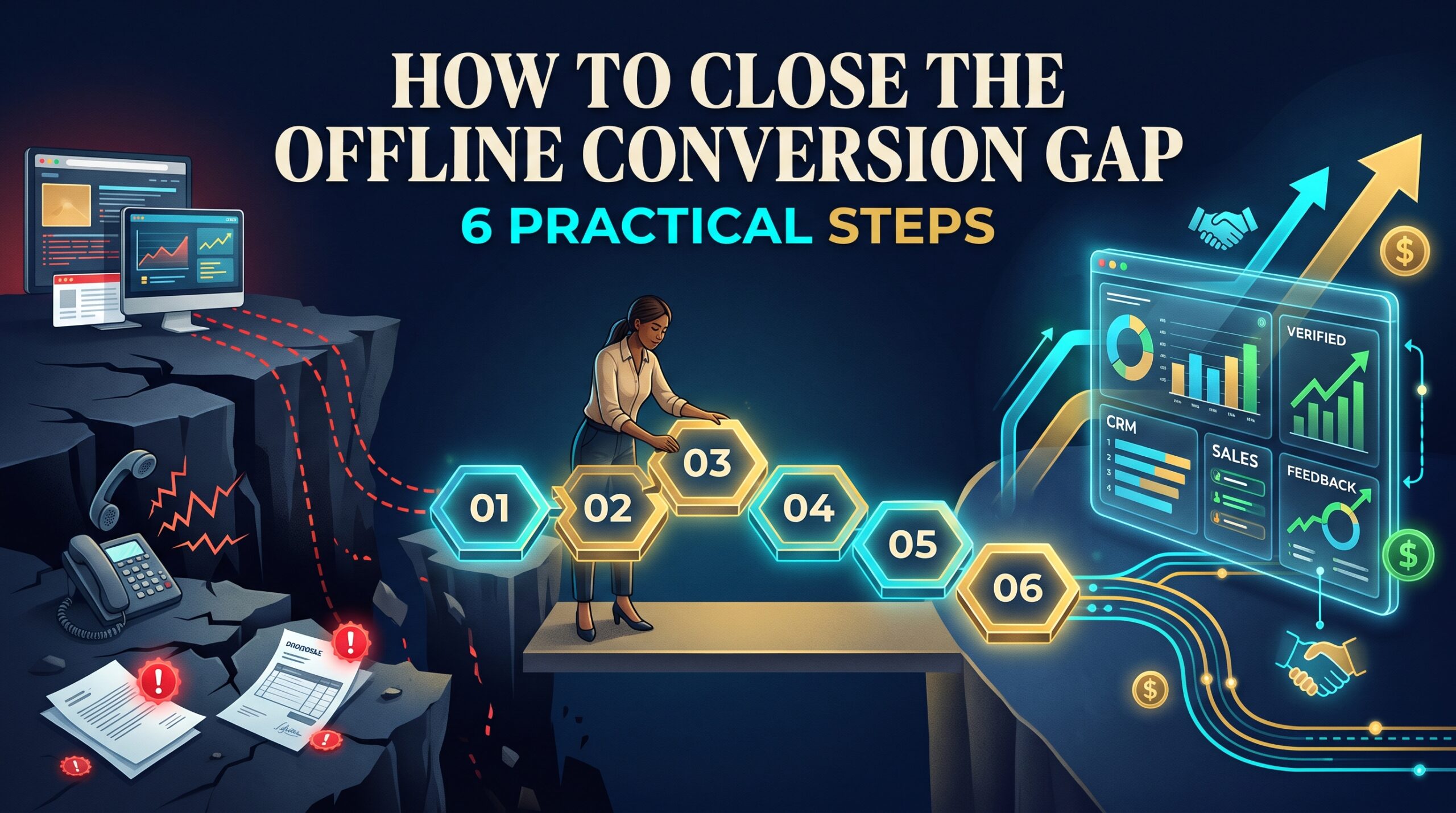
How to Close the Offline Conversion Gap: 6 Practical Steps
You do not need a huge budget to fix the offline conversion gap. You need a clear process and a few connected tools.
1. Decide which offline outcome matters
Pick the milestone that best predicts revenue. For some businesses it is a qualified lead, for others a booked appointment or a signed quote. Start with one or two, not ten.
2. Capture the click ID with every lead
Add hidden fields to your forms so the GCLID is saved alongside the name, email and phone number. Make sure your CRM stores it against the lead record permanently.
3. Track phone calls properly
Use call tracking tied to your ads and set a minimum call duration so only meaningful calls count. In the example in the Search Engine Journal guide, one account used a 210-second threshold because longer calls were more likely to be real prospects. Your own number should come from your own data.
4. Import offline conversions back into Google Ads
Create an import conversion action, then upload or automatically sync the click ID, conversion name, time and value. A daily or weekly schedule keeps the platform learning from fresh results. Google also offers enhanced conversions for leads, which uses hashed first-party data from your CRM to measure leads that later become customers, set up inside Google Ads or Google Tag Manager rather than by rebuilding your CRM. For the tag-based route, see Google’s enhanced conversions for leads setup guide for Google Tag Manager.
5. Report on revenue, not just leads
Build a simple report that shows spend, leads, qualified leads, sales and revenue by campaign. When your report ends at revenue, the offline conversion gap stops being a mystery and becomes a number you can improve.
6. Review monthly and feed the learning back
Look at which campaigns, keywords and suburbs produce the most revenue per dollar. Shift budget towards them, and pause what only produces unqualified enquiries.
Be realistic about the result. No tracking setup captures everything, and imported results take a few hours to appear in your account. The goal is not perfect data. It is data good enough to make better budget decisions.
Offline Conversion Gap Examples by Industry
- Home services and trades: most jobs are booked by phone, so call tracking and a CRM job status are essential.
- Healthcare and allied health: bookings are confirmed by reception, so appointment-attended status should flow back to the ad platform.
- Professional services: long consultations and slow contract cycles mean the real conversion happens weeks after the click.
- Real estate and finance: enquiries are plentiful, but only a small share qualify, so quality signals matter far more than volume.
- B2B and software: leads move through demos and procurement, so stage changes in the CRM should be imported as conversions.
Whether you operate in Perth, Canberra or Adelaide, the principle is the same: send the sales outcome back to the place where the marketing decision is made.
How Our Digital Marketing Team Can Help
Closing the offline conversion gap sits across several services, which is why it often falls between the cracks. Our team connects the pieces so your reporting tells one story from click to cash.
- Google Ads and PPC management that optimises for qualified leads and sales, not just form fills.
- SEO services that attribute organic enquiries to revenue as well as traffic.
- Social media marketing with lead tracking that follows the enquiry into your CRM.
- Performance tracking, reporting and marketing automation, available through our full range of digital marketing services.
We work with businesses across Australia. Explore our local pages for Sydney, Melbourne, Brisbane, Perth, Canberra and Adelaide, or see all service locations.
Want to know more first? Read our FAQs, browse the digital marketing blog, learn about our team, or contact us or call 1300 649 299 to talk through your reporting.
Frequently Asked Questions About the Offline Conversion Gap
What is the offline conversion gap?
The offline conversion gap is the missing link between marketing leads counted online and sales completed offline, such as by phone, in person or through a sales team. Because the ad platform never sees the sale, reports show leads but not revenue.
How do I track offline conversions in Google Ads?
Capture the click ID with each lead, store it in your CRM, then import the offline outcome, such as a qualified lead or sale, back into Google Ads using an import conversion action or enhanced conversions for leads.
Can I track phone calls as conversions?
Yes. Use call tracking linked to your ads, and set a minimum call length so short, unqualified calls are not counted as conversions.
How long does it take to see offline conversions in reports?
Imported conversions can take a few hours to appear. Long sales cycles mean the full picture builds over weeks, so review results monthly rather than daily.
Will fixing the offline conversion gap lower my cost per lead?
Not necessarily, and that is fine. The aim is a lower cost per sale. Cost per lead can even rise as the platform stops chasing cheap, low-quality enquiries.
Final Thoughts: Measure the Sale, Not Just the Lead
The offline conversion gap is common, fixable and expensive to ignore. Start by choosing the outcome that best predicts revenue, capture the click ID, connect your CRM and report on sales. Every step makes your next marketing decision a little less of a guess.
If you would like help connecting your ads to real revenue, get in touch with our digital marketing team today.