


Lead response time is the quietest leak in most Australian marketing budgets. You pay for the click, the form fill or the phone call, and then the enquiry sits in an inbox until Monday morning. By then your prospect has rung two competitors, booked one of them and forgotten they ever contacted you.
We call this the lead response gap: the distance between the moment a customer raises their hand and the moment your business actually answers. It rarely shows up on a report. Your ads look healthy, your cost per lead looks reasonable, and yet the sales don’t match the enquiries. This guide explains why the gap happens, what it costs, and how businesses in Sydney, Melbourne, Brisbane, Perth, Adelaide and Canberra can close it without hiring a call centre.
What Is the Lead Response Gap?
The lead response gap is the delay between a new enquiry arriving and a real, helpful reply reaching the customer. It covers web forms, phone calls, live chat, Facebook and Instagram lead ads, Google Business Profile messages and emails. Anywhere a person asks for help, the clock starts.
A slow lead response time is rarely a deliberate choice. Most owners assume the hard part of marketing is generating the enquiry. In practice, a surprising number of businesses win that part and then lose the customer in the follow-up. Your lead response time is the bridge between marketing spend and revenue, and if the bridge is slow, the money stops halfway across.
Why Lead Response Time Matters More Than Ever
Today’s buyers don’t wait politely. They search on their phone, open four or five tabs and message several providers at once. Whoever wins on lead response time, with a useful reply, usually sets the terms for everyone else.
The best-known research on this is the Harvard Business Review study The Short Life of Online Sales Leads. It audited 2,241 US companies and found that the average reply took around 42 hours, and nearly a quarter never replied at all. Its companion analysis found that firms contacting a lead within an hour were roughly seven times more likely to have a meaningful conversation with a decision maker than firms that waited even one hour longer.
A fair caveat: that research is from the United States and over a decade old, and Australian markets differ. But the direction is hard to argue with, and customer patience has only shrunk since smartphones and messaging apps made instant replies normal.
Why Australian Businesses Reply Too Late: 5 Common Causes
1. Enquiries Land in an Inbox Nobody Owns
When a website form emails “info@” and three people can see it, each person assumes someone else is handling it. Without a named owner and a clear deadline, your lead response time drifts from minutes to days.
2. After-Hours and Weekend Enquiries Wait Until Monday
Tradies are on the tools, clinics are closed, real estate agents are at open homes. Plenty of enquiries arrive exactly when nobody can answer them, and many Australians research and enquire in the evening or on weekends.
3. Marketing and Sales Don’t Talk to Each Other
Your agency delivers leads, your team follows up, and nobody measures what happens between the two. If lead response time isn’t tracked, it can’t be improved. This is one of the most common blind spots we see when reviewing a Google Ads account that appears to be performing well on paper.
4. Slow, Manual Processes
Copying details from a form into a spreadsheet, then into a CRM, then into an email takes minutes that feel like hours when a customer is waiting. Every manual step adds to your lead response time and gives a lead another chance to stall.
5. Waiting for the Perfect Quote
Many businesses hold back the first reply until they’ve prepared a full proposal. Customers would usually prefer a quick “Got it, here’s what happens next, and I’ll call at 2pm” over silence followed by a polished PDF.
What a Slow Lead Response Time Really Costs
Here is a simple, hypothetical example. Say you spend $6,000 a month on Google Ads and receive 100 enquiries, roughly $60 per lead. Forty of those enquiries get a reply the next day. If a fast reply would have won one in five of those people, that’s eight lost jobs. At an average job value of $1,500, you’ve left $12,000 on the table, double the ad budget, without changing a single keyword.
Your numbers will differ, but the pattern holds: a slower lead response time means fewer jobs. Improving lead response time is often the cheapest growth lever in the business because the expensive part, getting the enquiry, is already paid for.
Ideal Lead Response Time by Channel
| Channel | Realistic target | Common failure |
| Phone call from an ad | Answer live or call back within minutes | Voicemail with no follow-up |
| Website enquiry form | Personal reply within minutes in business hours | Generic auto-reply and nothing more |
| Facebook / Instagram lead ad | Contact quickly, while interest is fresh | Leads exported weekly in a spreadsheet |
| Live chat or messaging | Reply in seconds to a few minutes | Chat left unattended after 5pm |
| Email enquiry | Within the hour during business hours | Sits in a shared inbox |
| Google Business Profile message | Same business day at the latest | Notifications switched off |
How to Improve Your Lead Response Time: 7 Practical Steps
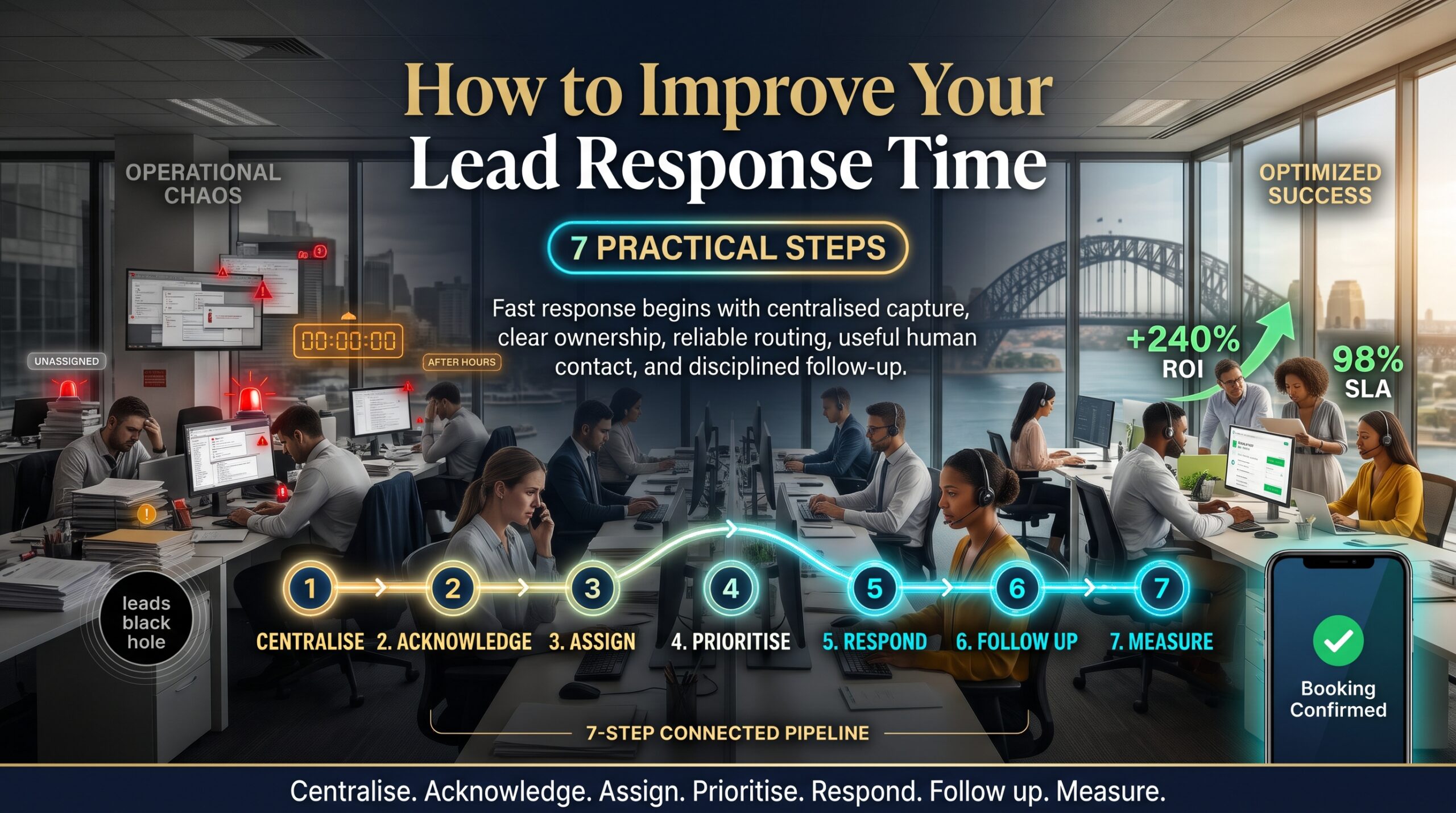
- Measure it first. Pull the timestamps for the last 30 enquiries and work out how long each took to get a real reply. Most owners are surprised, and not pleasantly.
- Give every lead an owner. One named person or one rotating roster, with a deadline. “The team” is not an owner.
- Set a lead response time standard. For example, every enquiry gets a human reply within 15 minutes in business hours and by 9am the next working day after hours. Write it down and review it monthly.
- Use instant, useful auto-responses. An automatic message that confirms receipt, sets expectations and asks one qualifying question buys you time and keeps the lead warm. It supports a human reply; it doesn’t replace it.
- Send leads straight to where people will see them. Push new enquiries to mobile notifications, SMS or a messaging channel, not just an inbox that only gets checked twice a day.
- Cover after-hours smartly. Use a booking link, call-back request or chat assistant that promises a specific callback time, then honour it.
- Tie it back to your ads. Report on cost per qualified lead and cost per sale, not just cost per click, so slow follow-up becomes visible in the numbers.
A short note on compliance: replying to someone’s own enquiry is normal business, but marketing messages are different. Check the Australian Communications and Media Authority (ACMA) guidance on consent and unsubscribe rules under the Spam Act before you automate email or SMS follow-ups. This is general information, not legal advice.
Fix the Whole Funnel, Not Just the Reply
Faster replies work best when the enquiries are good in the first place. If your traffic is vague or your offer is unclear, speed alone won’t save you. That’s why we look at the entire path from search to sale:
- SEO services to attract people actively searching for what you sell, including local searches like “electrician Brisbane” or “accountant Perth”.
- PPC and Google Ads management to reach high-intent customers, with call and form tracking so you can see how quickly each lead is handled.
- Social media marketing to build trust and keep your brand familiar while customers compare options.
- Digital marketing services that connect all of the above with clear reporting, so you know which channel produces revenue and not just clicks.
Not sure where your funnel is leaking? Read more about us or ask for a free marketing review through our contact page.
Lead Response Time by City: Where the Competition Is Fastest
Every market has its own rhythm, but a quick reply helps everywhere. Here’s how the gap tends to show up around the country:
- Sydney: crowded categories mean prospects compare several providers within minutes, so the first reply often wins.
- Melbourne: strong local competition across trades, health and professional services rewards businesses that respond and book quickly.
- Brisbane: growth and relocations generate steady enquiries, but busy teams on the road often reply late.
- Perth: time-zone gaps with eastern-states head offices can delay follow-up unless local routing is set up.
- Adelaide: tight local networks reward businesses with a reputation for being easy to reach.
- Canberra: government and professional buyers expect clear, prompt and well-documented communication.
See all service areas on our locations page.
Frequently Asked Questions About Lead Response Time
What is a good lead response time?
As fast as you can realistically manage, ideally within minutes during business hours. The Harvard Business Review research points to the first hour as the key window, and faster is generally better. Set a target you can actually keep, then tighten it over time.
Does an automatic reply count as a response?
It helps, but it isn’t enough on its own. An auto-reply reassures the customer that their message arrived. A real person with a helpful answer is what moves the sale forward.
How do I measure lead response time?
Compare the timestamp of each enquiry with the timestamp of the first genuine reply. A CRM, call tracking and your ad platform’s lead reports make this simple. Even a spreadsheet works for the first month.
How should I handle enquiries outside business hours?
Acknowledge instantly, promise a specific callback time, and keep that promise. A booking link or a clear “we’ll call you by 9am” message often performs better than silence or a vague “we’ll be in touch.”
Can better lead response time improve my Google Ads results?
It won’t change your click costs, but it improves what you get from every click. When more enquiries turn into customers, your cost per sale falls, which is the number that really matters. You can learn more about how paid search works in the official Google Ads resources.
Final Thoughts: Answer Faster, Win More
Paying for enquiries and then replying late is like filling a bucket with a hole in it. The fix is rarely more ad spend. It’s a clear owner, a realistic response target and a few simple systems that make speed the default. Improve your lead response time and you’ll often find that the marketing you already have starts working harder.
Ready to see where your enquiries are slipping away? Book a free consultation with our team, call 1300 649 299, browse our FAQs, or read more insights on the Digital Marketing Services blog.