


Lead source tracking sounds simple: a customer enquires, and you record which marketing activity brought them in. In practice, it’s one of the most common failure points in Australian small and medium businesses. The enquiry arrives, someone replies, a job is booked, and the CRM says ‘source: unknown’. Multiply that by hundreds of leads and you have a business spending thousands on marketing with no reliable idea of what works.
This guide explains why marketing source loss happens, what it costs, how to spot it and how to fix it step by step. If you’d like a team to set it up properly, our digital marketing services include performance tracking and reporting from day one.
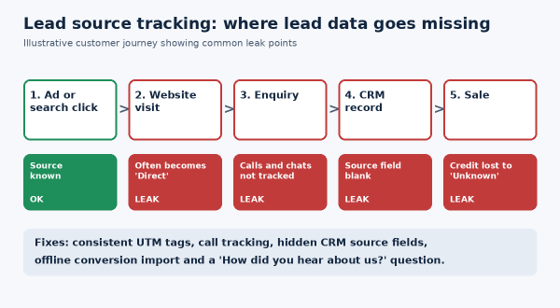
Illustrative example only.
What Is Marketing Source Loss?
Marketing source loss is what happens when a lead’s original source, such as a Google Ad, an organic search, a Facebook post or a referral, is never captured or gets overwritten along the way. The lead is real and the revenue is real, but the credit disappears. Good lead source tracking exists to stop that disappearance.
It matters because every budget decision depends on it. If you can’t tell whether search ads, SEO or social media produced your best customers, you’re forced to guess, and guessing tends to favour whichever channel shouts loudest in a report.
Why Australian Businesses Cannot Tell Where Leads Came From
Phone calls and WhatsApp enquiries sit outside web analytics
Many Australian service businesses get a large share of enquiries by phone, text or WhatsApp. Standard website analytics can’t see a call unless call tracking is in place. The customer clicked an ad on their phone, tapped the number and spoke to your receptionist, and the record simply says ‘phone enquiry’.
Missing or inconsistent UTM tags
UTM parameters are small tags added to links so analytics tools know where a visit came from. When one campaign uses ‘facebook’, another uses ‘Facebook’ and a third has no tags at all, your reports split or lose the data. Consistent naming is boring work that pays off for years.
The ‘direct’ traffic dumping ground
When an analytics tool can’t identify a visit’s source, it often files it under direct traffic. A business that sees a huge direct share isn’t necessarily popular. More often, the real sources have been lost. You can learn how channels are grouped in the Google Analytics Help Centre.
Cookie consent, browser privacy and ad blockers
Modern browsers limit tracking, many users decline cookies and some use ad blockers. Each of those reduces the data that reaches your reports. Australian businesses also need to handle personal information responsibly, and the Office of the Australian Information Commissioner is a good starting point for privacy obligations.
CRM fields left blank or overwritten
Even when the source is captured on the website, it often never reaches the CRM. Forms that don’t pass hidden source fields, manual data entry and ‘last touch’ overwrites all erase the original trail. Staff then pick ‘website’ from a dropdown because it’s the nearest option.
Several agencies, several dashboards
One provider runs ads, another manages SEO and a third handles social media. Each reports from its own platform, and each platform claims credit for the same lead. Without one agreed system of lead source tracking, the totals never match your sales.
What Poor Lead Source Tracking Really Costs
- Wasted budget: money keeps flowing to channels that look busy but don’t produce customers.
- Cutting the wrong channel: a quiet channel that actually influences sales can be paused by mistake.
- No proof of return: you can’t confidently answer the question ‘is marketing working?’
- Agency disputes: reports contradict each other and trust erodes.
- Slow growth: you can’t double down on what works because you can’t see it.
Signs Your Lead Source Tracking Is Broken
- A large share of leads in your CRM are marked ‘unknown’, ‘other’ or ‘website’.
- Google Analytics shows far fewer leads than your sales team reports.
- Direct traffic is your biggest channel, but you don’t run offline campaigns.
- Phone calls aren’t linked to any campaign or keyword.
- Ad platform numbers and CRM numbers never agree.
- Staff can’t explain how a lead found you when you ask.
How to Fix Lead Source Tracking in Eight Steps
- Define what counts as a lead. Form submissions, calls, chats and bookings should each have a clear definition and a tracked event.
- Set up GA4 conversions properly. Mark your key actions as conversions and test them end to end.
- Use consistent UTM tags. Create a simple naming guide and use the free Google Analytics campaign URL builder for every campaign link.
- Add call tracking. Dynamic or campaign-specific numbers connect phone enquiries to the ad, keyword or page that drove them.
- Pass source data into your CRM. Use hidden form fields so source, medium, campaign and landing page are saved with every enquiry.
- Import offline conversions. Send closed sales back to Google Ads so bidding learns from real revenue, as explained in the Google Ads Help Centre.
- Ask customers directly. Add a ‘How did you hear about us?’ question to forms and phone scripts. It’s low-tech, but it catches what software misses.
- Review monthly and reconcile. Compare analytics, ad platforms and CRM totals, and investigate gaps early.
Tools That Improve Lead Source Tracking
You don’t need an enterprise stack. For most Australian small businesses, a sensible setup includes GA4 for website behaviour, a call tracking service, a CRM that stores source fields, and a reporting dashboard that pulls them together. The goal is not more data. It’s one trustworthy version of the truth.
Self-reported attribution deserves a place too. When someone says ‘a friend recommended you’ after clicking a Google Ad, both facts matter. Software shows the last click, while the customer shows the influence.
Lead Source Tracking for Different Business Types
- Trades and home services: calls dominate, so call tracking and a simple job-source field are essential.
- Health and wellness clinics: online booking sources and phone bookings both need capturing, with privacy handled carefully.
- Real estate and finance: long sales cycles mean the first touch and the last touch can be months apart, so keep the original source stored.
- B2B services: multiple stakeholders and long journeys make CRM source fields and offline conversion imports especially valuable.
- eCommerce: connect ad platforms, analytics and order data so revenue is credited to the right campaign.
Lead Source Tracking Across Australian Cities
The challenge is the same whether you’re in Sydney, Melbourne, Brisbane, Perth, Adelaide or Canberra. Local competition, mobile search and phone-first customers mean source data leaks in similar ways everywhere. Businesses in Hobart and across New Zealand can also get support online.
See where we work on our locations page, or explore specific services such as SEO, PPC and Google Ads and social media marketing, all of which depend on accurate lead source tracking to prove their value.
Build Lead Source Tracking Skills In-House
If you want your team to understand analytics, paid media and conversion tracking properly, structured training helps. A practical digital marketing course can give marketers and business owners the fundamentals to question reports and set up tracking confidently.
Prefer to hand it over? Learn more about us and how we approach reporting, or read our FAQs for common questions.
Lead Source Tracking FAQs
What is lead source tracking?
It’s the process of recording where each enquiry or customer originally came from, such as Google Ads, organic search, social media, referrals or direct calls, and keeping that information through to the sale.
Why is my CRM full of unknown lead sources?
Usually because source data isn’t captured at enquiry time, calls aren’t tracked or the CRM overwrites the original source. Hidden form fields, call tracking and a clear data entry process fix most cases.
Is last-click attribution good enough?
It’s a reasonable starting point, but it ignores earlier touchpoints. Keep the first source and the last source in your CRM, and review both before cutting any channel.
How often should I review lead source tracking?
Monthly is a good rhythm for most businesses. Check conversion events, compare totals across platforms and audit a sample of leads by hand.
Where can I read more marketing guides?
Our blog shares regular guides on SEO, Google Ads, social media and reporting.
Stop Guessing Where Your Leads Come From
You can’t improve what you can’t see. Once lead source tracking is working, budget conversations change from opinions to evidence, and you can finally put money behind what genuinely brings customers through the door.
Want help finding the gaps? Request a free marketing review and we’ll look at where your lead data is leaking.